Author Archives: Derek A. Olsen

A New Proposal for Holy Women, Holy Men

The title says “new” but that deserves a certain amount of qualification. If you’re a regular reader, you know that this plan is something that has been working in fits and starts since last September. In fact, much of the material that I’ve been producing over the last few months finds a place in it.

If you’re not a regular reader, let me clarify what’s going on…  I was appointed to the Standing Commission on Liturgy and Music following General Convention last year. In the run-up to Convention, I had published an article and a follow-up in the Living Church and some blog posts that were quite critical of “Holy Women, Holy Men.” Imagine my surprise when not only was I appointed to the SCLM, but was asked to co-chair the Calendar Subcommittee. . .

My conversations across the church have led me to the conviction that HWHM is not a suitable resource in its current state. At the heart of the problem is a fundamental confusion about the nature of a Calendar, commemorations, and sanctity. There is no coherent theology that holds the document together. Major arguments for the inclusion of certain individuals rest on their importance or significance; others are included because they were the “first” something. It became clear to me that the Calendar was being made to bear too much freight. It had become a place to record significant people as well as a place to record individuals of holiness as well as a place to include individuals who were representative of a particular lobby within the church as well as (increasingly) a place to record historical events that had some kind of meaning for the church.

At the first meeting of the triennium, I floated the idea of an Almanac that might be used alongside the Calendar in order to enable the Calendar to focus on being a sanctoral Calendar—a place to commemorate individuals who had displayed holiness and lives evocative of Christian maturity. Or, to tie it more closely to the current parlance, those individuals who have fulfilled their Baptismal Covenants in fulsome and inspiring ways. Keep the Calendar a sanctoral Calendar; use an Almanac to capture historical important events and people.

As we discussed it and thought about it more in the intervening months, the idea became better fleshed-out and more clear. Support for the idea grew, but also a curiosity grew in terms of what such a scheme would actually look like on the ground: it’s fine to discuss it in abstract, but what would it look like and how would it really work on a practical level? At the conclusion of the last SCLM meeting, Ruth Meyers asked me to draft something concrete so that we could have a real artifact on the table to discuss as a potential reworking of the HWHM material.

Yesterday, I posted to the extranet (our official document repository) three documents that represent a concrete vision of this potential scheme: a 21-page draft proposal, an example calendar, and an additional bit of writing that needs to get folded into the main document somewhere. These will be discussed at our meeting next week. Monday morning has been set aside for a discussion about whether to move forward with this option or to continue in the current format.

Here’s the main concept:

In order to give a more accurate rendering of its contents, the book as a whole will called the “Book of Optional Observances” (this, in part, as a reminder that all of these days are optional and that no ferial days have truly “disappeared”…) and will have three major sections:

  • Holy Women Holy Men: A Sanctoral Calendar. The Calendar and accompanying proper material offered here will contain fewer commemorations than currently stand. In the example draft that I have put together, it contains only 137 entries, and these were selected in large measure with regard to saints who have parish dedications across the church and that better reflect the diversity of the church (i.e., 15% more women, 17% more people of color, 6% more laity than the current balances). The two central criteria operative are Christian Discipleship and Local Observance. However, a great deal of emphasis is placed on the fact that this calendar is intended to be illustrative and not comprehensive. That is, we fully expect individuals, parishes, dioceses, and provinces to maintain their own calendars and to supplement this list with the names of saints that reflect their lively local experience of sanctity. As such, the Commons of Saints are highlighted as essential resources for these locally identified celebrations. In particular, their attention is directed to the Almanac (about which more in a moment) as a source of potential commemorations.
  • Praying the Seasons: A Temporal Calendar. Currently non-Sunday Scripture readings for the various Seasons are disconnected, particularly when it comes to Ordinary time. Grouping the whole Temporale here will enforce the shape of the Church Year and remind people that this remains a viable option should they chose to exercise it.
  • Dedicating our Lives: Propers for Various Occasions and an Almanac for the Episcopal Church. Here, the Votives/Propers for Various Occasions are likewise given an equal standing with the other two options. The twist is that this section will also contain an Almanac. Everyone from the previous drafts of HWHM who does not appear in the Calendar—and some who do appear in the Calendar—will be found here as a representative/example of a particular votive. Full propers will be retained with the suggestion that the particular prayer/collect be used to conclude the Prayers of the People when used votively. If a local community chooses to observe the entry as a sanctoral occasion (having consulted the sanctoral criteria and discerned a congruence with their local experience of sanctity), they are free to do so and the propers are easily at hand. The chief criteria for the Almanac are Significance and Memorability. This will enable us to recognize and remember those individuals, events, and movements that made the Episcopal Church what it is today and that will inspire us in the future without requiring the burden of either asserting or proving their sanctity. Additionally, should sufficient documentable local, regional, and church-wide commemoration grow up around figures in the Almanac, it’s entirely possible that they could be remembered in the Calendar as well.

Here’s the proposed preface.

———————————–

Proposed Preface to the Book of Optional Observances

A New Perspective

The work before you represents a new approach to on-going non-Sunday Christian formation and liturgical celebration within the Episcopal Church. In the process leading up to the creation of the 1928 Book of Common Prayer, a Calendar Committee drafted a proposed Calendar for inclusion in that work. While it was not approved, a set of Eucharistic propers for the liturgical celebration of a saint was included. A Calendar Study committee was convened again in 1945 that finally produced the first official sanctoral calendar, approved in 1964. This material was supplemental to the Book of Common Prayer and was printed in a volume entitled Lesser Feasts and Fasts. The feasts pertained to the sanctoral celebrations; the fasts were the quarterly Ember Days and the provisions made for weekdays in Lent. Successive editions provided Eucharistic propers for a host of additional saints’ days and an increasing number of weekdays in the temporal calendar, partly in response to the growing custom of weekday Eucharists.

In 2003, under the direction of Presiding Bishop Frank Griswold—former chair of the Standing Committee on Liturgy and Music and its Calendar Subcommittee—General Convention directed the Standing Commission to revise Lesser Feasts and Fasts “to reflect our increasing awareness of the importance of the ministry of all the people of God and of the cultural diversity of The Episcopal Church, of the wider Anglican Communion, of our ecumenical partners, and of our lively experience of sainthood in local communities.” Now, over a decade later and after much deliberation and no little contention, we offer a resource that reflects the wide variety of Anglican understandings of sanctity, of liturgy, and of our common mission in Christ rooted in Baptism as exemplified in our Baptismal Covenant.

Through the preliminary work of the committee in arriving at this point, General Convention authorized a calendar containing upward of 295 commemorations celebrating 340 named individuals. The Calendar contained in the work before you contains fewer commemorations and individuals—and yet this resource as a whole contains all of these prior events and people and more! For those who became accustomed to certain celebrations and came to know new saints of God through the later versions of Lesser Feasts and Fasts or the preliminary editions of Holy Women, Holy Men, rest assured that no one has been “de-sainted” even though their name may not appear within the Calendar on the following pages. Instead, the Calendar now contains fewer commemorations with the intention that local observances and local theologies of sanctity should take precedence over a centralized list of names pushed down from above by a church committee.

The Calendar as Illustrative rather than Comprehensive

In obedience to the directive from General Convention to be more sensitive to sanctity in all of its diversity, the first instinct of the Calendar Subcommittee was to add names—to demonstrate inclusivity through a comprehensive Calendar. No matter how many names were added, however, we could never put on enough names to communicate the true diversity of the people of God. Furthermore, there would always be worthy individuals whose names would be omitted due to accidents of fortune or history rather than a lack of sanctity.

A different perspective was to offer a more minimal Calendar deeply committed to its own insufficiency.  This Calendar does not contain all of the saints of the Episcopal Church. It only begins to contain the saints who inspire, delight, trouble, and confuse us. Rather than creating a Calendar that is comprehensive, this Calendar is merely illustrative. That is, it presents a few representative examples of dedicated Christians throughout history who have invited us deeper into the life of God through their own witness. They illuminate different facets of Christian maturity to spur us on to an adult faith in the Risen Christ and the life of the Spirit he offers. As illustrations, they mirror the myriad virtues of Christ in order that, in their examples, we might recognize those same virtues and features of holiness in people closer to our own times and stations and neighborhoods. And, seeing them in those around us, we may be more able to cultivate these virtues and forms of holiness—through grace—as we strive to imitate Christ as well.

New in this resource is an Almanac for the Episcopal Church. While the purpose of the Calendar is to lift up individuals whom the Church should honor and imitate for their sanctity and their demonstration of the contours of a fully mature Christian faith, the Almanac’s purpose—sometimes complementary to the Calendar, sometimes overlapping—is to identify the significant and memorable individuals, events, and movements who have made the Episcopal Church what it is today. Some of them are well known; some of them are not. Some of them are Episcopalians; more of them are not. Nevertheless, through their leadership, thinking, writing, singing, praying, caring and working they have constructed the scaffolding through which this Church was built and will continue to grow. The Calendar celebrates sanctity—the end goal of a sacramental life of discipleship; the Almanac celebrates importance and significance. As the Calendar is intentionally illustrative, the Almanac contains some who may well fit both definitions. Indeed, as communities and parishes and dioceses consider their local understanding of sanctity, the Almanac may be a worthy first stop in exploring who beyond the Calendar may inspire you in your baptismal journeys.

Exhortation to Local Observance

Rather than attempting to mandate where holiness can be seen, this perspective liberates the Church to search for holiness both in its history and in its midst. In order to live into the potential of this approach, we exhort individuals, parishes, missions, and diocese to construct calendars of commemorations, using the Calendar contained here as a starting place. There are saints at every level of our lives and we diminish by a little the light of Christ in our world where they are not celebrated. The criteria for inclusion in the Calendar are presented on page XX. We invite you to read through the names, lives, and observances in this volume’s Almanac, and in other resources whether current or historical like Butler’s Lives of the Saints or Foxe’s Book of Martyrs, and in the lines scribed on the walls of your churches and the sidewalks of your streets to find narratives of witness that aid you in living out your baptismal vows. Create, circulate, and deliberate calendars and narratives that speak to the holiness of a transcendent God who blesses our lives in imminence.

In providing a minimal Calendar, we are offering a sign of trust in local communities. We recognize that there are a wide variety of understandings of sanctity across the Episcopal Church. Expecting them to be identical from the mountains of Honduras to the hills of Virginia to the high plains of Wyoming is unrealistic and does a discredit to the hardy faith that sustains lives in these regions and beyond. Local communities are thereby given a broader degree of freedom to discern who they identify as saints and how they perceive these individuals to be impacting their daily lives of faith. We pray that this approach will lead to the identification of a wider array of indigenous saints—some of whom should be shared more broadly across the church, and some of whom should remain local observances united to their own particular place and home.

Expanding Liturgical Horizons

This resource places a new focus upon some liturgical materials that have been long been part of the Christian tradition and that have been included in the 1979 Book of Common Prayer since its adoption: propers for Various Occasions. Growing out of the medieval tradition of votive masses, the propers for Various Occasions lift up particular aspects of the Christian life and witness that deserve to be celebrated, yet not at the expense of our Sunday celebrations of the Resurrection. Recapturing the use of these liturgical compositions can help local communities express liturgically their joys and struggles in solidarity with those around them. Within this resource, the Almanac of people and events significant to the Episcopal Church has been linked to many of these Various Occasions, providing a natural and ready opportunity for exploring these liturgies. It is our hope that, having been exposed to them in this context, they will more naturally and easily spring to mind when their use is warranted.

Expanding Formative Horizons

In the past Lesser Feasts and Fasts was primarily understood as a book for non-Sunday Eucharistic celebrations. However, within the past decade, social media and an evolving array of digital devotional materials have revealed that this work and its subsequent formulations have an important role in shaping personal as well as communal devotion. These aren’t just collections of liturgies—these resources help modern Episcopalians learn about themselves, their faith communities, and the history of the wider Church. In recognition of this reality, attention has been given (particularly within the Almanac) to presenting a broader narrative that communicates how some of these events and individuals are linked together, and how they make the Episcopal Church who we are today.

Entries in both the Calendar and the Almanac have been associated with a variety of “tags.” These tags help provide an instant context for the individuals, movements, or events being remembered. Too, they create relationships across the material, highlighting common themes or connections between apparently disparate people. The tags may relate to gender, ethnicity, region of impact, or identify some of the virtues and charisms that may be seen in them. In digital editions of this resource, hyperlinking will allow you to explore across the Calendar and Almanac by means of the commonalities.

In addition, digital tools have given a broader prominence to the Daily Office leading to more questions concerning how Lesser Feasts are represented in these services. In order to clarify the intersection of this resource with the Daily Office, direction will be provided at the head of each section explaining its proper use.

The Shape of the Work

In order to accomplish the goals outlined above, this resource contains three major parts. The first part is “Holy Women, Holy Men: A Sanctoral Calendar” that contains the calendar of observances and which provides commons for the celebration of various kinds of locally identified saints as well. The second part is “Praying the Seasons: A Temporal Calendar” that provides Scripture lessons, collects—where appropriate—and other Eucharistic propers for celebrating weekdays within the Church’s liturgical seasons. The third part is “Dedicating our Lives: Various Occasions and an Almanac for the Episcopal Church” that contains the propers composed for Various Occasions and the Almanac that connects these Occasions to people, events, and movements that have shaped the Episcopal Church.

————————————-

Also, here’s the head of the general rubrics on the Church Calendar:

————————————-

Optional Observances and the Calendar

In the section entitled “Concerning the Service of the Church,” the Book of Common Prayer clarifies the normative services of the Episcopal Church:

The Holy Eucharist is the principal act of Christian worship on the Lord’s Day and other major Feasts, and Daily Morning and Evening Prayer, as set forth in this book, are the regular services appointed for public worship in the Church. (BCP, 13)

Eucharistic propers (collects, Scripture readings, and proper preface) are provided in the Book of Common Prayer for the days when the Eucharist is the principal service.  The Calendar section at the front of the prayer book identifies these Eucharistic feasts by placing them into three categories, ranked by priority: Principal Feasts, Sundays, and Holy Days. Normatively, on all other days, Morning and Evening Prayer are the Church’s official public services. However, as celebration of the Eucharist has become more frequent, many parishes now offer weekday Eucharists on days for which the prayer book does not assign propers.

The prayer book provides a range of six possible options for the celebration of the Eucharist on these ferial or non-feast days. These options are:

  1. To celebrate a Major Feast that has fallen elsewhere in the week as provided in the prayer book,
  2. To celebrate a Lesser Feast as a Day of Optional Observance appointed in the Church’s Calendar,
  3. To celebrate a Lesser Feast as a Day of Optional Observance not appointed in the Church’s Calendar by using the Commons of Saints,
  4. To celebrate the season by using the propers of the preceding Sunday,
  5. To celebrate the season by using the propers appointed for a day in the given week of the season, and
  6. To celebrate an occasion provided for in the propers for “Various Occasions.”

To facilitate the use of these authorized options, this resource contains the propers for fixed Holy Days, Commons of Saints, and Various Occasions given in the prayer book and those authorized since the adoption of the prayer book, and propers for Days of Optional Observance recognized for Church-wide use but not included within the prayer book. The propers in this resource are grouped into three sections by type for the sanctoral cycle, the temporal cycle, and various occasions.

Directions for the appropriate use of the various kinds of propers are provided at the head of each section, but here are some general guides for use:

  • These propers are not to be used on any day for which the prayer book has appointed propers.
  • If a Major Feast that falls in the week will not be celebrated with a Eucharist on its indicated day, it is most appropriate that a midweek service will observe the Major Feast in order to retain the prayer book’s emphasis on the significance of these occasions.
  • “Feasts appointed on fixed days in the Calendar are not observed on the days of Holy Week or of Easter Week” nor should propers for Various Occasions be used within this period (BCP, 18).
  • In keeping with ancient tradition, the observance of Lenten weekdays ordinarily takes precedence over Various Occasions or Lesser Feasts occurring during this season.
  • Since the triumphs of the saints are a continuation and manifestation of the Paschal victory of Christ, the celebration of saints’ days is particularly appropriate during the Easter season.

Optional Observances and the Daily Office

The propers in this resource are provided for use in the Eucharist; specific directions on whether or how they may be used in the Daily Office are described at the head of each section.

As a rule, the Scripture readings appointed for optional observances are not to be substituted for the Daily Office Lectionary given in the Book of Common Prayer. Since the observation of a Lesser Feast would make that celebration’s collect the “Collect of the Day,” the collect of a Lesser Feast may be used as the “Collect of the Day” In the Office whether a Eucharist for that observance is being locally celebrated or not. Since the Daily Office operates primarily within the movement of the temporal Cycle, the collect of the preceding Sunday or Principal Feast may be prayed after a sanctoral “Collect of the Day” in order to maintain this liturgical connection. The collect for a Various Occasion should not replace or displace the Collect of the Day but may follow that Collect or the conclusion of the Office at the discretion of the officiant.

———————–

I want to draw attention to some of the items towards the end of the preface. I see this proposal representing three major advances beyond HWHM here. First, it puts the sanctoral Calendar on a more solid theological footing focusing on sanctity. Second, it clarifies the status of the three major options for celebrating a non-Sunday Eucharist. Third, it recognizes how HWHM is currently being used in the wild. I see it more online and in social media than in physical churches. This proposal takes this devotional use seriously and provides an enhanced framework for utilizing it to learn both church history and be introduced to the primary saints recognized by our tradition.

I truly believe that this proposal offers a win-win situation. For those who value the diversity currently present in HWHM, all of it has been retained. For those concerned about the sanctity of those on the sanctoral Calendar, a smaller, more carefully vetted list will adhere to the published criteria. For those concerned with a loss of ferial days, the resource as a whole better communicates the optional character of all of the Lesser Feasts and clarifies the relationships between the various options. I think this proposal offers the church a better-rounded, more useful resource that displays a more coherent implicit theology of sanctity and offers greater sensitivity concerning how it will actually be used.

Let me know what you think . . .

A Point of Clarification: Some people have asked to see the names on the actual Calendar. My response is to warn you that we’re at least four major hurdles away from that point.

  • The first hurdle is for the SCLM to adopt this proposal. This is by no means a fore-gone conclusion and I expect that there will be a certain amount of resistance to it or at least to some aspects of it.
  • The second hurdle will involve hashing out the new criteria for the Calendar.
  • The third hurdle would be a concomitant hashing out of criteria for the Almanac.
  • It’s not until the fourth hurdle that we can actually start naming names for the Calendar.
  • And again for the Almanac…

While I do have an example list it is in no way official or even semi-solid from an official point of view. So—that’s too much uncertainty for me to produce any such list at the present time; it would be both premature and presumptive.

Saint Augustine’s Prayer Book Update

Lots of balls in the air at the moment, some with very hard deadlines…

My prayer book spirituality work for Forward Movement has a contract and a due date—October 15th. There’s quite a lot to be done on it in a short space of time. Expect to see a lot more material on this coming out soon.

The next SCLM meeting is next week. Please be praying for us then. After having floated the idea of an alternative vision for Holy Women, Holy Men at the past couple of meetings, Ruth Meyers requested a full-on draft of what such an alternative would look like. That has been completed; I’ll post it for the Commission today and hopefully post excerpts from it here tomorrow.

One of the potential  monkey-wrenches in the deadlines for both the spirituality project and the SCLM material was waiting for the page-proofs for the Saint Augustine’s Prayer Book to come back. I got the edited material back to Forward Movement in March. They’ve been doing the publisher thing with it since then. I had been given June 10th as a hopeful date for page proofs, but it looks like things are going to take a little longer; they’re still doing their editing/spell-checking/indexing/etc. So, the page-proofs won’t be out for a bit and therefore publication will likely be in the latter half of the year—but I have high hopes that it’ll be on shelves by the end of the calendar year.

So—while it didn’t impact the SCLM material, there’s a good chance it’ll arrive while I’m trying to finish up the spirituality text. We’ll see; I’ll keep you posted when I know more…

Basic Disciplines for Liturgical Worship, Part II

This part is coming along slowly… I do see the relationship between intentionality/participation/attentiveness as being three aspects of the same whole and may juggle around the order of these a bit once they’re done. We’ll see…

—————–

Participation

When we come before the Lord to worship, when we prepare ourselves to once again take the plunge into the unending choruses of praise to God and to the Lamb, it means committing whole hog. If we’re there to praise, then let every part of us that can join in the praise. Check the psalms. Does it really say, “Let the sea thunder and all that is in it; let the field be joyful and all that is therein. Then shall all the trees of the woods fold their branches over their trunks and just stand there stoically while everyone else is singing as if they’re too cool to join in (perhaps in a slightly ironic way)?”

I didn’t think so. And yet, I see this almost every week at worship… Since I recognize that singing adds a few different things to the mix, let’s begin by talking about the speaking parts, then touch on singing.

During colonial times, there were two people who appeared at the front of the church to make worship happen: the priest and the clerk or reader. If you go into some of our oldest Episcopal churches that still have their original furniture you might see a two-level pulpit: the priest stood in the upper part while the clerk stood in the lower. The priest was, well, to be the priest, and he’d say the “priest” parts. The clerk was a layman, and his job was to lead the speaking parts for the people. On one hand this setup is a benefit—with the clerk there, you know when to say what you needed to say. And, in a time where the congregation had varying degrees of literacy, it was always helpful to have a least one guy you knew could read! On the other hand, it also became entirely too easy to sit back and let the clerk do “his” thing instead of seeing him as the leader for “our” thing. The Victorian liturgical scholar Walter Frere speaks unfavorably of this duet between either the priest and the clerk or—later—the priest and the choir where, in both cases, the congregation sat in as the audience while someone else performed their parts. Frere describes this—quite rightly—as a low-point for liturgy.

Hogarth_Church[A 1736 print by engraver and satirist William Hogarth entitled “The Sleeping Church”]

We’re there for a reason. We have been given a Book of Common Prayer so that we can pray together in common. The fact that the Anglican tradition has always provided access for the whole people to the whole service speaks volumes about what we understand participation to be. When the book says “People” it doesn’t intend a token representative, but the whole body. Thankfully, the clerk phenomenon has not been a big part of Episcopal worship in recent years, but the point still stands—the prayer book tradition is a participatory tradition; the intention has always been that the congregation should be engaged intellectually, spiritually, and verbally in what is going on.

Participation does, at the minimum, three things. First, it’s much easier to engage and remain engaged in the act of worship when we are verbally involved. The act of listening, responding, rolling the words around in our mouths, connects us to what is going on around us. Second, it represents an assent to the content of the words. When we join in, it’s an act of affirming what’s being said—we believe it, or at least have an understanding that this is what the church teaches and that we’re committed to even as we may wrestle with some phrases or aren’t fully feeling others at the time. Third, it both signals and creates a rapport with the people around us. We don’t come to the public worship of the church by ourselves and for our own sake. Public worship is corporate worship in the most literal of senses—we form a body: the Body into whom we were baptized. As we come together, we are separate members of the Body of Christ joining back together, re-forming the body in a simultaneously spiritual and literal sense. When someone stands silent in such a gathering, their actions call into question their relationship to the rest of the body.

Participation in singing as a slightly different story, but the same principles should be kept in mind. Not everyone sings—I understand that. There are different patterns of participation at worship. Some folks are better singers than others. Some are shy. Some don’t read music, or don’t read it well enough to feel comfortable joining in from the very beginning of a song—particularly if it’s a new one. Some guys might think it “unmanly” (and they’d be totally wrong on that count). Some were raised in churches where singing isn’t common or is frowned upon—whether officially or by long-standing custom.

After pointing out the myriad instructions to sing so many parts of the service from the psalms to the prayers to the creeds to the hymns, Victorian scholar John Henry Blunt confidently concluded, “The devotional system of the Prayer Book is, therefore, a singing system; and the Church of England is what the Mediaeval, the Primitive, and the Jewish Churches were, ‘a Singing Church.’” As framed notices in choir rooms across the world will attest, the great early African theologian St. Augustine of Hippo really did say that “To sing is to pray twice” (once with the words, and again with the beauty of the voice raised in song).

The goal should be for the whole congregation to be able to join in song at the congregational singing parts—service music and hymns alike. That means as congregants, we have a responsibility to raise our voices and join them with those around us—even if it’s softly! But we aren’t the only ones who have a say in this situation; the musicians and worship planners can have an impact here as well. Some music—particularly some of the pop-styles of recent years—works better for individual performers than large groups. A wide vocal range from high to low notes, complex rhythms, jumps in pitch are all very hard for the average congregation to sing and to sing well together. The choice of the music can sabotage the intention to participate even if it’s entirely inadvertent on the part of the musicians.

Participation in the service, whether in the sung or the spoken parts, is an important part of aligning yourself with the intention and the purpose of the liturgy. That’s not to say that there aren’t other modes of participation—not all participation is active participation—but vocal participation in conscious consonance with the Body around you is a hallmark of Anglican liturgy at its best.

Basic Disciplines for Liturgical Worship, Part I

Alright—having done a fair amount of work on saints in advance of the end-of-June SCLM meeting, I’m returning again to my other main writing project: the prayer book spirituality work in process for Forward Movement. (You can find the earlier posts related to this topic by clicking on the Prayer Book Spirituality Project tag.)

This section is taking a bit more time than some of the others, but that’s ok because 1) it’s one of the more important sections and 2) I feel like this is the section that so many current accessible works on the prayer book are missing. Thus, it’s worth doing it right. It might take us several parts to get through it and re-writes are inevitable…

The “Basic Disciplines” section intentionally parallels the “Basic Principles” section because it builds where that one left off. You might like to revisit that one before continuing here.

——————-

Basic Disciplines for Liturgical Worship

The Need for Disciplines

On my more optimistic days, I have faith in the formative power of the liturgy. Much of the work of the liturgy on the soul occurs passively. That is, it’s a matter of trusting the process. We may not feel it working on us, but following the prayer book system, being in the liturgies, participating in the prayers, will have a long-term effect whether we realize it or not. Woody Allen has famously commented that eighty percent of success is simply showing up—and that certainly seems to apply here!

However, at the end of the day, just being there isn’t enough. After all, if it were, then there would be no such thing as bad priests; we could rest secure knowing that anyone who was invested and participated in these patterns would be an ok person, and that we could simply trust the formation. But things aren’t so simple. There are people who live in these liturgical cycles yet who seem not to be transformed and changed by them, who can exhibit the baser tendencies of human nature unaltered by their liturgical practice.

Showing up is important—but it isn’t enough.

We sometimes use the metaphor of a rock in a river to talk about incremental change over time. A rock dropped into running water will be smoothed and polished over years from the passage of the water around it and from rubbing against the rocks around it. And yet—a rock that has sat in a river for a thousand years may be just as dry on the inside as one that has never seen the water. Just because the outside has been changed, doesn’t necessarily mean that the heart of it has been touched.

I don’t want to be a rock: I want to be a sponge. I want to be permeated and saturated by the environment that I’m in. I want my insides to be touched by the years of these experiences as much as my outsides. I don’t want to just experience the cycles of the liturgy, I want to be altered and transformed by them.

If eighty percent of success in the liturgy is just showing up, than the other twenty percent may well be about making it count, about opening up the insides. This is where we get to the disciplines that can make the most of our liturgical practice. These are the long-term habits that help us open our minds and our hearts to what is going on around us, that crack open our shells and enable to waters of life to seep within us and change us throughout. As we discussed in a previous section, it may be helpful to think about these from an active perspective: these are the things that we do to cooperate with God’s transforming grace. Alternatively, they may resonate with you in a more passive construction: these are the things that help us stop resisting God’s embrace and help us relax into the person of God.

Intentionality

The first discipline is intentionality. Think of this as focusing our attention on the big picture. If it’s not enough to simply show up, then we can at least show up holding in our minds the reason why we’re showing up! God is not made greater through our worship of him; God is already greater than that. We do worship God for our own purposes, and we would do well to remind ourselves of what those are and to carry them into worship with us. We don’t simply go to fulfill an obligation, or to gain another bargaining chip with God. Rather, we come because God is worthy of praise, and in the very act of praise and adoration we recall to ourselves and those around us who God is and what God has done for us.

Before we participate in any act of worship—whether alongside hundreds of others or alone and by ourselves—we would do well to stop and fix in our minds what it is that we are about to participate in. We are here to worship God. We are here to enjoy the presence of God, and to participate in the process of communicating with God alongside and in communion with a great company who have praised him through the ages. Beyond that fundamental principle shared by all forms of liturgical worship, the various liturgies have their own purposes. Be aware of what it is you are about to do. Collect to mind the general intention of the service in which you will participate.

Furthermore, worship is part of a pattern of orienting ourselves towards God and aligning our stories, beliefs, and principles with God’s. As we consider the general intentions of the service, we also want to connect these general intentions with what’s going on with us. The liturgies tend to speak in generalities—we thank God for blessings, we lift up concerns. As part of being intentional, as we take a moment to consider the big picture, we should also take a moment to consider the specific intersections between the language of the liturgy and the events of our lives. What are those specific things we are thankful for? What are the actual concerns burdening our hearts and minds?

I’ll talk more about the general intentions of the various services as we discuss them and will clarify just what I mean here as we focus on them in turn. By specific intentions, though, I mean that we may choose to hold in mind a particular aspect of the broader purpose that touches on something going on in our lives at that moment.  For instance, if someone has just passed away, we might choose to participate in a Eucharist holding them in mind, recognizing that—as the Eucharist connects us with the whole communion of saints—we might be thankful for their place in our lives and be comforted knowing that our connection with them through the Eucharist has not ended but that we share the same banqueting table with them. Or, if we have been touched by a particular joy as we approach the Daily Office, we might hold that joy before us as a concrete example of those things for which we praise and thank God.

(More to come as it gets written…)

Sanctoral Dedications of Episcopal Parishes

Dr. Kirk Hadaway, official numbers person for the Episcopal Church, was kind enough to provide me with a list of every single Episcopal parish in the world as of a few years ago. I have now gone through that list with an eye to discovering to whom our various churches are dedicated with a particular interest in sanctoral dedications. That is, which saints are churches dedicated to? What patterns of dedication do we see? Specifically, what is the breakdown between red-letter saint dedications and black-letter (i.e., those directly in the purview of HWHM and the Calendar Subcommittee), and what do those tell us about established local observance of saints across the Episcopal Church?

Here are some of my findings.

The starting list of 7,204 names displays quite a range of naming possibilities. Broadly speaking, Episcopal parishes take a name either from:

  • a saint to whom they are dedicated,
  • a feast of the (temporal cycle of the) liturgical year,
  • a person of the Trinity,
  • a theological concept, or
  • their location

Of these options, there are a total of 4,773 dedications of parishes to saints. The number of parishes dedicated to saints is slightly smaller than this as some parishes are dedicated to two saints and there are a handful that are dedicated to three saints.

Most of these sanctoral dedications are fairly straight-forward. It should be noted at this point, however, that there were a few difficulties in the overlap of names. Because most saints are referred to in the list (and in church dedications) by a single name, there is potential confusion between individuals who share a common name. The most ambiguity occurs in the following cases:

  • John: these churches could be dedicated to
    • John, the Apostle and Evangelist
    • John the Baptizer
    • John the Divine, author of Revelation (who may or may not be the same as John the Apostle)
  • James: these churches could be dedicated to
    • James the Greater, Apostle
    • James the Less, Apostle
    • James of Jerusalem (the Just), brother of our Lord Jesus Christ
  • Augustine: these churches could be dedicated to
    • Augustine of Hippo
    • Augustine of Canterbury
  • Ant(h)ony: these churches could be dedicated to
    • Antony of Egypt
    • Anthony of Padua
  • Gregory
    • Gregory the Great of Rome
    • Gregory of Nyssa
    • Gregory the Illuminator
    • Gregory Nazianzus

I realized only in the course of this analysis that Elizabeth could refer (primarily) either to Elizabeth of Hungary or to Elizabeth, the Mother of John the Baptizer. Those with qualifiers indicated “Hungary” but this would require further scrutiny to clarify the true state.

I did research a number of these by checking parish websites; in some cases I could tell which saint was indicated, in others it was inconclusive. (Pro tip: if your church is dedicated to a saint, say a little bit about them on your parish website!) If I could not tell, I went with the more common which is the first saint of the group named above.

Of these 4,773 dedications, 3,596 are dedicated to saints having red-letter days (75.3%). Of the red-letter saints, these are the ten most popular:

Paul of Tarsus, Apostle 482
John, Apostle and Evangelist 435
Andrew, Apostle 284
James the Greater, Apostle 265
Luke, Evangelist 248
All Saints 233
Mark, the Evangelist 231
Mary the Virgin, Mother of our Lord Jesus Christ 211
Simon Peter (Cephas), Apostle 208
Stephen, Deacon and Martyr 170

These top ten represent (in turn) 76.9% of the red-letter sanctoral dedications and therefore 57.9% of all sanctoral dedications in the Episcopal Church.

Of the 1,177 black-letter dedications, these are the top ten:

Francis of Assisi, Friar, 1226 92
George, Soldier and Martyr, c. 304 90
Alban, First Martyr of Britain, c. 304 82
David, Bishop of Menevia, Wales, c. 544 62
Anne, Parent of the Blessed Virgin Mary 61
Christopher, Martyr at Antioch, c. 304 59
Timothy, Companion of Saint Paul 59
Martin, Bishop of Tours, 397 57
Augustine, Bishop of Hippo, and Theologian, 430 43
All Angels 35

If “All Angels” is removed as it connects to a red-letter day, the next entries would be a tie: Margaret, Queen of Scotland, and Patrick, Bishop and Missionary of Ireland, both at 32. The top ten list here represent 54.4% of the black-letter dedications.

Given the red-letter vs. black-letter balance and the overwhelming presence of male saints in the red-letter category, it’s no surprise that the overall gender balance shows massive disparities. 4,344 dedications are to male saints (91%); 429 are to female saints (9%). Of the female saints having dedications, here are the top ten:

Mary the Virgin, Mother of our Lord Jesus Christ 211
Anne, Parent of the Blessed Virgin Mary 61
Margaret, Queen of Scotland, 1093 32
Elizabeth, Princess of Hungary, 1231 31
Mary Magdalene 16
Martha of Bethany 11
Agnes, Martyr at Rome, 304 10
Clare, Abbess at Assisi, 1253 8
Catherine of Alexandria, Virgin and Martyr, c. 305 6
Monnica, Mother of Augustine of Hippo, 387 6

The breakdown between clergy and lay saints is not as disparate as one might expect, even when holding with Church tradition and identifying all twelve Apostles as bishops. 4,007 dedications are to bishops/priests/deacons/religious (83.9%); 766 are to laity (16.1%). Here are the top 10 lay dedications:

Mary the Virgin, Mother of our Lord Jesus Christ 211
George, Soldier and Martyr, c. 304 90
Alban, First Martyr of Britain, c. 304 82
Anne, Parent of the Blessed Virgin Mary 61
Christopher, Martyr at Antioch, c. 304 59
John the Baptizer 55
Joseph, Adoptive Father of Jesus Christ 36
Margaret, Queen of Scotland, 1093 32
Elizabeth, Princess of Hungary, 1231 31
Mary Magdalene 16

Shifting gears slightly, when we look at the saints to whom dedications are given, 133 saints have dedications. Of these, there are 107 black-letter saints with dedications.

Of these 107, 37 saints with a total of 173 dedications do not appear in HWHM. These are the top ten saints having dedications but not formally appearing within the Calendar:

Christopher, Martyr at Antioch, c. 304 59
Gabriel, Archangel 19
John the Divine, c. 90 11
Raphael the Archangel 9
Edward the Confessor, 1066* 9
Catherine of Alexandria, Virgin and Martyr, c. 305 6
Giles of Provence, Hermit, c.710 5
Helena, Protector of the Holy Places, 330 5
Anthony of Padua, priest and doctor of the Church 5
Charles Stuart, King and Martyr, 1649 4

* There’s likely some confusion here between the two sainted King Edwards of England, Edward the Confessor and Edward the Martyr. However, there were a total of 10 between the two of them.

It’s worth nothing that up until the introduction of HWHM, this list would have been headed by Saint George with 90.

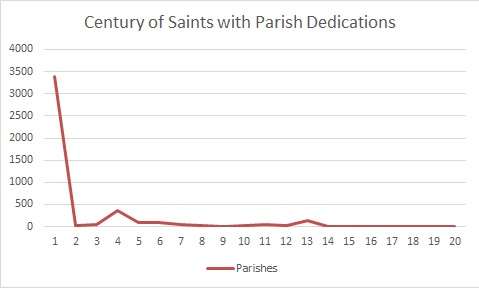
When we look at the breakdown across time we see an interesting pattern. Again, when looking at the full set, the skew towards the first century and the red-letter apostolic saints is unmistakable:

CenturyParishDedAllHere’s the supporting data:

Century Parishes
1 3400
2 25
3 36
4 355
5 82
6 98
7 58
8 24
9 10
10 20
11 42
12 24
13 142
14 5
15 2
16 4
17 6
18 0
19 0
20 0

This is the graph and data when red-letter saints are removed:

CenturyParishDedBlack

Century Parishes
1 161
2 25
3 36
4 355
5 82
6 98
7 58
8 24
9 10
10 20
11 42
12 24
13 142
14 5
15 2
16 4
17 6
18 0
19 0
20 0

The spike in the 13th century is primarily due to Francis of Assisi (92 dedications) and Elizabeth of Hungary (31 dedications) [but see the caveat above on the correct identification of dedications to “Elizabeth”].

Thus, the most recent saints to receive dedications are the three in the 17th century, Charles Stuart, King and Martyr (4 dedications), William Laud (1 dedication), and Rose of Lima (1 dedication).

Of the new prospective saints introduced with HWHM, only four have dedications:

George, Soldier and Martyr, c. 304 90
Cecilia, Martyr at Rome, c. 280 1
Rosa de Lima, 1617, Witness to the Faith in South America 1
Lucy (Lucia), Martyr at Syracuse, 304 1

Again, these figures indicate a certain lack of attention to the local identification and observance of saints in the construction of HWHM.

While there is more data that can be teased out of this material, let me leave you with one final data set. This chart displays the dedications for parishes with Spanish titles representing not only Hispanic parishes in the US but also our dioceses in Central and South America:

MaryBVM 33
PaulAp 18
Joseph 13
PeterAp 12
MichaelArchangel 10
JohnAp 9
FrancisAssisi 9
JohnBaptist 8
Stephen 7
MatthewAp 7
AllSaints 7
LukeAp 7

The first include four dedications to the Virgin of Guadalupe/of the Americas, three dedications to Our Lady of Supaya, two dedications to Our Lady of Carmel, one to Our Lady of the Angels, one to Our Lady of the Forsaken, and one to Our Lady of Walsingham. Again, if we want to recognize local observance, we would do well to consider these dedications as we consider outreach into non-Anglo demographics.

While there were dedications where the title indicated primary languages of French, Korean, Japanese, and Lakota, the French mirrored the English, and the others did not rise to the level of being statistically significant.

HWHM Trial Balloon

I’ve been told that one of the problems with my approach to HWHM is that I haven’t paid sufficient attention to 2003-A100, the GC Resolution that authorized the project. Here it is for your reading pleasure:

Resolved, That the 74th General Convention direct the Standing Commission on Liturgy and Music to undertake a revision of Lesser Feasts and Fasts 2000, to reflect our increasing awareness of the importance of the ministry of all the people of God and of the cultural diversity of The Episcopal Church, of the wider Anglican Communion, of our ecumenical partners, and of our lively experience of sainthood in local communities; and be it further

Resolved, That the SCLM produce a study of the significance of that experience of local sainthood in encouraging the living out of baptism; and be it further

Resolved, That the General Convention request the Joint Standing Committee on Program, Budget, and Finance to consider a budget allocation of $20,000 for implementation of this resolution.

General Convention, Journal of the General Convention of…The Episcopal Church, Minneapolis, 2003 (New York: General Convention, 2004), p. 593.

I have now given this resolution a certain amount of attention. (Whether it’s been sufficient is not for me to say…)

In particular, I want to draw your attention to one phrase of the first Resolve clause: “…and of our lively experience of sainthood in local communities” and to the second Resolve clause in its entirety with a special focus on this phrase: “experience of local sainthood in encouraging the living out of baptism.”

Let me tackle the second Resolve first and answer the question that naturally proceeds from it. No—this study mandated by GC on the significance of the local experience of sainthood was never produced. What I’ve learned since being on the Standing Commission is that not everything mandated by GC gets accomplished. Sometimes it’s because they’ve offered a good idea that is simply not possible financially or for other reasons. The poster child for this is the requirement that everything Convention or its underlying bodies does or produces must be translated into both Spanish and French. That’s a great idea and recognizes the breadth of our church—but no funding is provided to do it. As a result things get translated slowly and occasionally if at all. And, sometimes, there are things resolved that fall off the radar and are forgotten. And, sometimes, there are things resolved that specifically get forgotten. I don’t know where this study falls, but it never occurred.

Nevertheless, between the second Resolve and the phase on “local communities” in the first, it seems that “local” is a very important part of what HWHM ought to be about! To honor the intention of the resolution, the collection needs to speak to this point in a compelling fashion.

What does “local” mean here? I think it’s ambiguous and that there are two possible and not exclusive answers that make sense in light of the rest of it. The first is that we need to trust local communities in their identification of sanctity in local people. The second is that we need to trust local communities in their identification of sanctity as it makes sense to them in their location, whether the individual honored is “local” or not.

For instance, if I were to suggest to a classic Virginia clergyman that he celebrate a feast for a little statue of the BVM called the Virgin of Supaya, he’d roll his eyes and mutter. And he’d be perfectly right in doing so based on the history and theology of his locale. If, however, I suggested to the clergy who serve the two Episcopal churches in the Diocese of Honduras named after the Virgin of Supaya that they not celebrate it,  they’d equally roll their eyes and mutter—based on their local theology. (She’s the patron of Honduras.)

Where is this local in HWHM? . . . What if—and I’m going out on a limb here—what if HWHM represents (no doubt, unintentionally) a distrust of local discernment by imposing in a top-down fashion such a large number of commemorations that don’t connect to local environments? In its attempt to be inclusive of people from a variety of locales and situations, has it actually created a centralized hegemonic artifact that might suppress rather than enhance local practice?

In order to celebrate the local, then, a reduced sanctoral calendar might be favorable especially if it were to explicitly say that the people included are only a tiny subset of the full number of the saints of God and are examples to spur local thought. A healthy recommendation of a variety of sanctoral texts from a variety of perspectives—Foxe, Butler, etc.—and a general uplifting of the Commons of Saints might do a far better job of promoting a “lively experience of sainthood in local communities” then a book imposed from on high filled with people and situations that don’t connect to the local environment.

Too, the incorporation of a parallel Almanac in the same volume could likewise offer suggestions for celebration beyond the official Calendar.

Thoughts?

Pentecost RBOC Update

  • Activity around the house is gearing down and preparing for summer mode; ballet and track are over for the girls. That means less shuttling them around—for now in any case…
  • Projects are heating up.
  • My next section on the Prayer Book Spirituality Project is in progress but isn’t near completion. I’d hoped to already have it done before now but other things keep interfering.
  • That having been said, I did lead an Adult Ed forum Sunday on the material that will form the basis of the “Spirituality of the Eucharist” chapter. I got rave reviews on it! And realized I needed at least another chapter in addition to that one to fit in everything I needed to say to scratch the surface on just the spirituality bit…
  • Coding work for another project with Forward Movement is well underway.
  • I need to do a bunch more work on the saints for HWHM before the end of June. Thus, it’ll have to get off the ground fairly soon.
  • Page proofs for the St Augustine’s Prayer Book should be arriving in early to mid-June for review before printing.
  • I need to solve a persistent preferences issue with the breviary. I’ve decided that this has to get done by the end of the week. Just not sure when it’ll get fit in.

Open Source Liturgy & Music

I just ran across a fascinating post which has actually been out there for a while, now. It’s a discussion by Adam Wood, part of the Chant Renaissance in the Roman Catholic online world, about what it would mean to truly offer sacred music on an Open Source model.

It gives me quite a lot of things to think about, but the bottom line squares quite well with the proposal that I put before our Standing Commission on Liturgy and Music: our music and liturgy need to be freely available without cost in ways that developers can leverage in order to produce ways of accessing and using them either freely or at a cost.


On Celebrating Matthias

When I got up this morning and checked my Twitter feed it was clogged by all manner of English Anglican folks saying nice things about St Matthias. This is a Pond Difference that is worth mentioning as it gets into one of the interesting anomalies you discover as you dig into the kalendar.

The Episcopal Church celebrates St Matthias on February 24. The proper day… Now, if you’re a liturgy geek, you’ll recognize this particular feast because it falls on the old Latin bisextile day—leap day for Romans. This could be shifted to the 25th depending what year you were in. Furthermore, it is right around the same time as Ash Wednesday and, potentially, Lent 1 and often falls during Lent. As a result, there are all sorts of potential discussions about precedence rules when these things start coinciding and learnéd discussions of ancient authorities can be had.

Around Vatican II, the Roman Church decided that it was tired of these discussions and moved Matthias out of this liturgical “danger zone” and out into the late Spring where the only thing it can conflict with is Ascension Day. And Easter Sundays. And Pentecost. Great thinking, Romans! The Church of England followed suit and accommodated to the new date. (A similar thing happened to St Thomas as well.)

We didn’t. We kept the old date.

So—when we say “old date,” what precisely do we mean…?

Matthias

Well, here’s a little snippet from the Sacramentary of Rodrade written in 853 that shows the feast of Matthias on February 24. (The 6th day before the kalends of March).

Now—here’s what’s weird: this particular snippet comes from the verso (back side) of the first folio. That also contains a mass for St Mark (April 25th) right under it. On the front side of the page it has masses for Emerentiana, Macharius and Companions (Jan 23rd) and St Praejectus with memorials of the Conversion of St Paul (January 25th) in a different hand. In other words, this page is a later addition into the mass book; it didn’t come with Matthias in it!

Indeed, when we take a look at where he ought to fall (and note the really different handwriting here as opposed to above), we see a great big gap between Valentine (Feb 14th—but you knew that…) and Gregory (March 12th):

NoMatthias Thus, we have one of our earliest and best examples of the Gregorian Sacramentary lacking the feast of St Matthias; it gets added in later. So, too, does the Conversion of Paul which takes second fiddle to St Praejectus, himself a late addition.

What’s going on here?

Remember that kalendars were originally all about the local… When we look at the very earliest Roman kalendars the majority of the names found there are from saints in the area. There are a few famous names from North Africa, but Frere sums up the evidence this way in his classic Studies in Early Roman Liturgy: I. The Kalendar:

“Apart from such outstanding cases [Holy Innocents, Timothy, Cyprian, Perpetua and Felicitas], an entry is normally made in the Roman Kalendar because there is a place which demands an anniversary.” (25)

“Indeed, we may watch the Kalendar grow, as new churches arise in the city, and claim an anniversary.” (26)

[After a discussion of the suburban cemeteries/catacombs and the uncertain addition of saints who lay 7 miles or more outside of Rome]”It is evident that topological considerations have been the determining feature of the Kalendar.

The saints of Porto (19 miles) and Ostia (15 miles) are too far off to be taken into account, though they may figure in the early records under the heading Romae. Six or seven miles is the limit, and that proves in practice to be too far. So the suburban cemeteries supply names to the Kalendar mainly from an inner ring within a radius of about four miles.” (28)

“The occurrence of such notes [place names with reference to the saints/martyrs] in the Service-books corroborates the view expressed above, that the shrines in the cemeteries have given rise to the observance of these anniversaries.

At a later stage the outlook changes. The Kalendar is regarded less as a direction where the official Mass will be said, and more as a direction given to a priest serving a church to tell him what Mass he will say there on a certain day [when]. It is not clear by what stages the official Mass at the cemetery was given up. But the main cause is clear enough, viz. the destruction of the Catacombs and cemeteries. And the effect is clear also, viz. that the Curia’s directory became the parish priest’s Kalendar.” (29, emphasis added)

Thus, if you want to be on the earliest Western kalendars, you darn well better be buried within 4 miles of the center of Rome! (St Valentine, for instance, was right out the Via Flamina and therefore in a well-situated but less prestigious spot than those like Callistus, Fabian, and other early pope-martyrs buried in the Callisti or Praetextati cemetaries right off the Via Appia.)

As Frere indicated, in time, this local Roman kalendar based on how far the pope and his entourage were able/willing to walk became the kalendar for the average parish priest in the Roman area. Then, as things spread, it became the default kalendar for wherever “Roman” books went! It was not until the 8th century in Norther Europe that bishops and others decided that it might not be a bad idea to round out the kalendar and to make sure that all of the apostles and evangelists were on it—not just those who had been martyred around Rome. Thus, it’s from this point that we start seeing certain New Testament saints making their way into the kalendars and mass-books; some faster than others.

So, too, it is in this early medieval period that we should look for an explanation as to the odd occurrence of so many of these days on or around the 24th or 25th of the various months… Staley in his Liturgical Year supposes that this was somehow in connection to the dates of Christmas and the Annunciation, but it remains a mystery to me.

Thus, Matthias does get a celebration as one of the universalizing tendencies of the Carolingian liturgical consolidation. You don’t find feasts for him early. Then, in these latter days, some of these apostles have suffered the further indignity of being switched around because the early medieval dates are now less convenient. Hence, the English doing Matthias today (May 14th) whom we’ve already honored earlier in the year (February 24th).