Lenten Reflection

I haven’t put up many pieces on the Episcopal Cafe recently. That’s not a function of anything other than being overly busy, and not having anything compelling bubbling up to the top. However, I do have a new piece up as a kick-off to Lent.

Lent can be a mixed bag around the Church. Some see it as a time to curb minor food cravings without reference to its deeper intentions; others see it as a time for renewed advocacy of a particular cause. Too, I think some people in some years need more or less Lent than others. For me, I’m feeling a need for more and for a turn back to the personal side of Lent. I need to honestly take stock of where I am, and there’s no way I can do that without taking sin seriously.

In that light, my post invites us to a Lenten reflection about the dark places within ourselves, and the Gospel call to let in the light of Christ.

Decision on Calendar Issues

The Standing Commission on Liturgy and Music met yesterday afternoon. One of the top topics was the future of commemorations and the state of the Episcopal sanctoral calendar. I had pulled together the work of the subcommittee into a document which was further modified by committee and which was subsequently posted to the SCLM blog where we asked for feedback. Based on the feedback and discussion in the SCLM, we will be moving forward with a reconfiguration of HWHM tentatively retitled “A Great Cloud of Witness” (likely with a clear and descriptive functional title appended to the Scriptural phrase…).

Here are the key features of the recommendations:

  • We clarify that the sanctoral calendar of the Episcopal Church consists of those days celebrated by all—the Principal Feasts and Holy Days of the Book of Common Prayer—and that the calendar in the prayer book reflect this.
  • We clarify that all other days are—as they have always been—optional. They can be celebrated or not at the discretion of the presider or parish.
  • We move away from a canonization model. Instead, the resource follows a “family history” model and identifies people who have been significant and important for the church being the church in the 21st century.
  • The recognition of sanctity of any of the people either on or off the list is a local decision.
  • The central ecclesial act of recognizing a saint is eucharistic celebration. In order to clarify that the list of names and the resource is not a sanctoral calendar, entries will contain a collect for devotional purposes but not full eucharistic propers. However, suggestions for appropriate propers will be provided should a local community choose to honor a given person or group as a saint or saints.
  • Speaking of collects, the prayers currently contained in HWHM will be overhauled. We agreed that the goal is for each commemoration to have an actual collect that is appropriate for worship (not a supplementary mini-bio as one person said in the meeting…). However, given the scope of work, some entries may share appropriate Common collects if unique rewrites cannot be completed for all.
  • The bios will also be redone to remove errors and to highlight Christian discipleship.
  • Because this is not a sanctoral calendar there will be a clause in the criteria allowing for extremely occasional inclusion of non-Christian people with the clear understanding that the bio needs to be upfront about the fact that this is an exception and be equally clear on how the person’s life, witness, work, whatever directly connects to the church’s understanding of Christian discipleship. For example, all of the Dorchester Chaplains will be included—even Rabbi Goode—because the a significant part of the witness of this group is their ecumenical nature. To leave out Rabbi Goode would undercut an important aspect of the commemoration. Is anyone suggesting that Rabbi Goode is a Christian, “anonymous” or otherwise? No. Is his inclusion here indicating that the Episcopal Church now thinks of him as a saint? No. Instead, it recognizes that he was an integral part of a heroic gesture of compassion and ecumenical cooperation that local congregations are free to observe or not at their discretion.
  • The Weekday Temporal material and the Commons for Various Occasions will be collected together and will receive greater emphasis as equally valid alternatives on non-festal days.

There are other things that haven’t been fully decided that still remain to be hashed out. Too, none of this is official until General Convention renders a decision on it. GC may decide to scrap the whole thing and go back to HWHM. However, this represents what we’re working to pull together and put before convention.

As regular readers know, I don’t consider this a perfect solution. There are a number of things I would do differently if it were up to me, but it’s not—this is part of a church-wide process that must satisfy a wide range of theological and political positions. However, it is a workable solution, and addresses many of the flaws identified in HWHM. Whether we’ve just created new flaws, only time will tell…

Just Because…

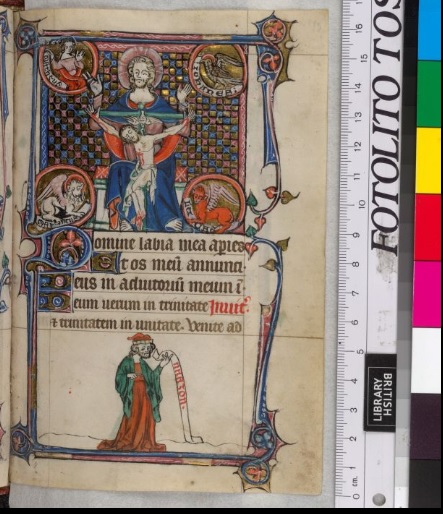
Here’s the front image for the Hours of the Holy Trinity in the Taymouth Book of Hours according to the Sarum Use (f. 32v). The whole thing can be found here at the British Library: (http://www.bl.uk/manuscripts/FullDisplay.aspx?ref=Yates_Thompson_MS_13&index=2) Why? Because it’s awesome!

Sarum_Trinity_Taymouth

Future of the Electronic Anglican Breviary

The attempt to fund an electronic version of the Anglican Breviary did not succeed. I do think that the Kickstarter model is a good one, and I can definitely see doing some projects through it. However, This one didn’t quite work out. I’ll have to ponder what didn’t work and what might work…

Actually—one thought I have already had is that this might be the right way to fund much smaller scoped projects like the preparation of e-book editions of classic Anglican texts. I’m thinking here of things like Proctor and Frere’s commentary on the (English 1662) BCP or Dearmer’s Parson’s Handbook. (And when I say e-book, I mean more than just a scan dumped into a .pdf file; I mean fully searchable, proper formatting, hyperlinked indeces, cross-references, and all.)

In any case, the ending of this funding attempt does not mean the end of an Anglican Breviary project. I do think that it is an important resource that needs to go online in an easily accessible form. I will continue to work to that end. However, it will have to move towards a back burner while I work on projects that I have already committed to and that do bring in income.

I’m thinking that the best way forward will be to reduce the scope and to work on those sections that will be of most use to most people. Thus, I anticipate starting on the Matins readings of the temporal cycle. Once these are in electronic form, I will be able to incorporate them as a further patristic option within the St. Bede’s Breviary, leveraging them either as additions to the Noon office or as options for a third reading at Morning Prayer or a second/third reading at Evening Prayer.

Several people have contacted me with offers to help with transcription work—I hope to be able to send a note to you all within the next few weeks and identify some specific material with which to begin.

So—this particular effort has ended, but the project will move on nevertheless.

Totally Random Thought on Processions

Processions as a liturgical movement within the church are not a common feature of current church life and worship. They were a much bigger deal in the medieval period and, when considering the liturgical life of a typical medieval cathedral or abbey, a specialized book called a processionale is an important resource. Naturally, there is a Sarum processional and there were some in the late 19th/early 2oth Sarum Revival who were interested in bringing back the custom of processions, noticably Percy Dearmer.

I want to make on quick, rather random note on processions and their use in the modern church… I’ll do so by introducing this image that I just ran across and that reminded me of what I wanted to say on this topic. From the British Library, here’s a miniature of a bishop preaching from Harley MS 4425, f. 167v:

Note where he’s preaching from: a platform set on barrels… 

What does this have to do with processions? Furniture. More specifically the kind of furniture that did and didn’t exist in major medieval worship spaces vs. the furniture that exists in American churches.

A cathedral is quite different in size than a modern American church. Too, the furniture did not have the same relationship to the space that ours does now. Namely—pews, pulpits, and other kinds of fixed furniture. Processions as envisioned in medieval sources work a heck of a lot better in a big space without fixed pews! Many of the modern processions I’ve seen or participated in end up with a long trail of people squeezed between a wall and long lines of set pews with very few being able to effectively “group” at a station. So—if we’re going to do this, how do we do it better?

Benedictional of St Aethelwold up!

A couple of posts in the pipeline dealing with church politics stuff are sidelined for a most important announcement: the British Library has put on line the splendid Benedictional of St. Æthelwold!

Æthelwold was the teacher of Aelfric, the chief guy my dissertation was about, so this is a big deal for me. The manuscript illustrations are simply beautiful—they’re definitely worth the time to look through.

Calendar Subcommittee Recommendations Up for Comment

The Standing Committee on Liturgy and Music (SCLM) is now making public an interim update on the Calendar. The proposal is located here. It recommends splitting the current material into two parts (whether physically located in two volumes or not—that’s still under discussion): “A Great Cloud of Witnesses” which is cast as a “family history” rather than a sanctoral calendar and “Weekday Eucharist Book” (which needs a better name) for collecting the material for weekday Eucharistic celebrations into meaningful groups.

This is the result of much consultation, much thought, and several contentious meetings. It’s not perfect, it still has some unknowns, and it has some weaknesses, but overall I think it’s a stronger way forward than Holy Women, Holy Men.  At this point, we’re essentially putting it up for public vote. While adding nuance might be nice, chances are this is going to be a up or down decision—HWHM or GCW—based on the feedback left on the blog.

I’m working on a post to provide some of the context for some of the choices that might seem odd. I thought I’d have it up by now, but life has intervened. Hopefully later today!

The Beauty of Holiness

I was struck again this morning with the strong sense of the inter-relation between beauty, truth, and holiness. Beauty is a pathway into the soul. We need to be more attentive regarding the ways that we can work this truth into our daily practices of faith and life…


On the Choice of Offices

A correspondent sent me a note over the weekend, noting (correctly) that if one wishes to undertake the discipline of the Office, it’s good to pick one primary form and stick with it. His question, then, was which one:

  • The BCP Offices,
  • The Roman Liturgy of the Hours,
  • The Anglican Breviary,
  • The Monastic Diurnal + Matins

Others could be added to these…

It’s a good question and one that I spent some time wrestling with a few years ago. I can’t tell him, or you, or anybody else what to do, of course, but here’s the answer that I’ve come to and that works well for me.

I’m a Prayer Book Catholic within the Episcopal Church. Now—as we’ve noted before, the term “Prayer Book Catholic” isn’t exactly the same in England as it is in America due to the differing situations of our respective prayer books. However, I take it to mean that I am obliged to the prayer book and its system of devotion as understood and supplemented by the riches of the Western liturgical heritage.

Thus, for me, I am obligated to the Morning and Evening Prayer Offices of our authorized Book of Common Prayer—that’s part and parcel of what it means to be an Episcopalian.

Now, the Offices contain a number of permissions—like the liberty of antiphons and hymns—that open the door to the riches of our heritage found in books like the Anglican Breviary, the Monastic Diurnal, the English Office,  the Brevarium RomanumA Monastic Breviary, and many others.  As a result, I have and use these other books to supplement my prayer book services both in terms of material and in terms of additional offices.

Indeed, this was part of the genesis of the St. Bede’s Breviary. I wanted to create something that was faithful to the rubrics of the prayer book, but that also could easily include the other items when I had the time and desire for them. As a result, I have my “House Use” that I use regularly and can choose from the other leaner versions as circumstances require. However, at the root is always the framework and content of the BCP Offices.

In Advent and Lent I like to add in the Little Hours and will often do so—or attempt to do so—from the Anglican Breviary or Monastic Diurnal or the Sarum Primer.  I say attempt because I don’t often succeed. My zeal for devotion frequently outstrips the time I have for it.

And that raises another important point. The BCP Offices are the least onerous of the list above. After all, it’s two Offices a day (only four if Noon and Compline are included). If I were to take the Anglican Breviary as a base office discipline,  I would be obligated to pray all of it. Even doing so in aggregation would be difficult, and at this season of my life I just can’t imagine being able to juggle it all consistently, day in and day out. I hope this will change some day—but can’t see it happening until the girls can drive themselves!

For me and the discipline I’ve chosen, the Anglican Breviary represents the best source for supplementary material. I want to be able to pull in its antiphons and hymns. More particularly, I’d love to be able to draw on its patristic readings to augment the Offices.

So, if some are you are wondering why I’m proposing the Anglican Breviary project while also talking about the importance of the prayer book, this is how it fits together. I know several people who faithfully pray the breviary and who have asked me to work with it; I’d also like to make it available to interweave with the prayer book itself.

At the end of the day, selecting an Office discipline is a balance of ecclesial identity, devotional continuity, and an honest appraisal of your own ability to stick with the choices you’ve made. The heart of the Office is the repetition of the Psalter. If you can’t consistently make it through the whole psalter in your chosen Office discipline, then you’ll want to reassess it and consider if you’ve bitten off more than you can chew, and what will work for you. It’s always easier to start with the shorter and more basic and graduate to more complex forms as you go.  But don’t be hasty about it either. Liturgical formation—like all other life-long habits—should be measured in months, seasons, and years rather than days and weeks.