Category Archives: Medieval Stuff

Some Observations on the Dialogues of Suplicius Severus

The Dialogues of Sulpicius Severus are a fairly little-known work by one of the more obscure Western Fathers. Nevertheless, he forms an important part of the flow of information and theology of the early monastic movement from East to West. When we think Gaulish monastic father figures these days, John Cassian springs to mind; however, Sulpicius Severus played a complementary role.

More needs to be said about Sulpicius than what I will say now, but a few items must be mentioned to give a proper context for these notes.

First, while Cassian used the dialogue form for the purpose of teaching ascetical practice, spirituality, and theology, Sulpicius preferred to describe lives and events that focused upon proofs rather than techniques. That is, his works tended to be stories about Martin of Tours (his main work being the principal Life of St Martin) and other monks but while Cassian used stories to identify practices or to make an ascetic point, Sulpicius preferred tales of the miraculous to confirm the efficacy of the monastic way of life. (If I had to offer one theory as to why modern students of Christian spirituality know Cassian and not Sulpicius it would be  the modern disdain for miraculous elements that strain the bounds of credibility.  Sulpicius tends not to strain the bounds of credibility, rather he blows past them at a tremendous speed…)

Second, Sulpicius stood in conscious literary relationship with Jerome. This deserves an examination in its own right—there are some very interesting passages in the Dialogues that wrestle with Jerome as a teacher and author where Sulpicius both attempts to cast himself in direct relationship with Jerome but also attempts to supplant him literarily.  In any event, Sulpicius was very much a student of Jerome’s writings and if Sulpicius tended to the miraculous, it was a technique he learned from Jerome and his three monastic lives: the Life of Paul, the Life of Hilarion, and the first monastic novella, the Life of Malchus the Captive Monk.

In the literature from the desert there are a number of fairly common topoi that serve as miraculous confirmation of ascetic practices. These include clairvoyance, miraculous healings, ascetics appearing in dreams, vivid encounters with demons, vivid encounters with angels, supernatural feeding, ascetics exhibiting angelic properties, and honor shown to holy men by wild and vicious creatures. Jerome especially picks up the last in his two more imaginative lives, the Life of Paul and the Life of Malchus. In the Life of Paul, Antony is given directions to Paul’s cave first by a centaur (VP 7), then by a satyr (VP 8), and finally by a wolf whom he sees entering Paul’s dwelling (VP 9). During their conversation, a raven brings them bread (VP 10). Likewise, in the Life of Malchus, the centerpiece of the dramatic escape of Malchus and his chaste wife comes when they take refuge in a desert cave that turns out to be a lions’ den and their pursuers are killed by the fierce beasts but the chaste couple are left unharmed.

So—these are the literary models from which Sulpicius is drawing. The whole point of the Dialogues is similar to that of Cassian’s Conferences, namely, how can the life and piety of the Eastern monks be translated into religious life in the West? Sulpicius seeks to establish that this translation has successfully occurred in the preeminent person of Martin of Tours. Indeed, Martin has so successfully accomplished this feat that his signs and wonders surpass those of the Eastern monks.

To make his point, he casts a first-person narrative where a far-traveling friend, Postumianus, returns from a voyage East and regales Sulpicius and his companion “the Gaul” with tales of the Eastern monks. This occurs in the first book of the Dialogues; the second and third books are the rejoinder where Sulpicius, the Gaul and a host of other eyewitnesses describe tales of Martin of Tours and his mighty miracles.

Stepping back from the particulars, Sulpicius seems to be working with a particular problem of place and social location. The lure of the desert is bound up with the solitary life, the pure life. Even the Eastern monastics who lived in communities were living away from the rest of sinful humanity. How, then, could Martin have the same kind of holiness without the physical remove from society? Furthermore, one of the wonders of the Egyptian monks in these early days was their refusal to distinguish between persons based on their status. A bishop would receive the same reception as a peasant; rulers and prelates came to them in the desert. In the West, it was Martin who was traveling to see the royal and the powerful. How could these be explained without compromise?

Sulpicius begins by focusing his first book on three miraculous topoi in particular: supernatural feeding, ascetics with angelic properties and the reception of ascetics by vicious beasts. I’m going to suggest that he selects these for a very particular reason and that in doing so, he is communicating one of the theologies at the root of the early Eastern monastic movement: the return to Eden. That is, the solitary monk through the ascetic process can conditionally recover elements of the Edenic state where, like Adam, he dwells in constant communion with God, enjoys an angelic state of being, the little food he requires is supplied without toil by nature itself, and he lives in harmony with the wild beasts.

As the character Postumanius narrates his trip through Egypt, we see this theme playing out in a number of ways. Section 1.13 gives us a solitary who, through the help of an ox and a well has created a garden paradise in the desert:

There was also a garden there full of a variety of vegetables. This, too, was contrary to what might have been expected in the desert where, all things being dry and burnt up by the fierce rays of the sun produce not even the slenderest root of any plant. But the labor which in common with his ox, the monk performed, as well as his own special industry, produced such a happy state of things to the holy man; for the frequent irrigation in which he engaged imparted such a fertility to the sand that we saw the vegetables in his garden flourishing and coming to maturity in a wonderful manner. On these, then, the ox lived as well as its master; and from the abundance thus supplied, the holy man provided us also with a dinner.

Further, even the desert provides this holy man with the fruits he needs complete with a requisite vicious beast:

Then after dinner, when the evening was coming on, our host invites us to a palm-tree, the fruit of which he was accustomed to use, and which was at a distance of about two miles. For that is the only kind of tree found in the desert, and even these are rare, though they do occur. I am not sure whether this is owing to the wise foresight of former ages, or whether the soil naturally produces them. It may indeed be that God, knowing beforehand that the desert was one day to be inhabited by the saints, prepared these things for his servants. For those who settle within these solitudes live for the most part on the fruit of such trees, since no other kinds of plants thrive in these quarters. Well, when we came up to that tree to which the kindness of our host conducted us, we there met with a lion; and on seeing it, both my guide and myself began to tremble; but the holy man went up to it without delay, while we, though in great terror, followed him. As if commanded by God, the beast modestly withdrew and stood gazing at us, while our friend, the monk, plucked some fruit hanging within easy reach on the lower branches. And, on his holding out his hand filled with dates, the monster ran up to him and received them as readily as any domestic animal could have done; and having eaten them, it departed. We, beholding these things, and being still under the influence of fear, could not but perceive how great was the power of faith in his case, and how weak it was in ourselves.

The lion not only does not eat the ascetic but has returned to the vegetarian state of the garden.

Similarly, section 1.14 gives us a she-wolf who eats bread from an ascetic’s hand and who apologizes in canine form when she takes two biscuits one night instead of her accustomed one. In 1.15 a lioness beseeches healing from an ascetic for her five cubs born blind. He heals them and she brings him the skin of a rare animal as a cloak as thanks. In 1.16, an ascetic new to the desert ate poisonous roots which put him in torment. Accordingly, an ibex came and taught him which roots were safe and which were dangerous.

Section 1.17 makes a deliberate connection with the two great (literary) monastic exemplars, Antony and Paul. Within this same section, connected as it were to these figures, is the preeminent Edenic anchorite:

I saw the Red Sea and the ridges of Mount Sinai, the top of which almost touches heaven, and cannot, by any human effort, be reached. An anchorite was said to live somewhere within its recesses: and I sought long and much to see him, but was unable to do so. He had for nearly fifty years been removed from all human fellowship, and used no clothes, but was covered with bristles growing on his own body, while, by Divine gift, he knew not of his own nakedness. As often as any pious men desired to visit him, making hastily for the pathless wilderness, he shunned all meeting with his kind. To one man only, about five years before my visit, he was said to have granted an interview; and I believe that man obtained the favor through the power of his faith. Amid much talk which the two had together, the recluse is said to have replied to the question why he shunned so assiduously all human beings, that the man who was frequently visited by mortals like himself, could not often be visited by angels. From this, not without reason, the report had spread, and was accepted by multitudes, that that holy man enjoyed angelic fellowship.

Like (the pre-Eve) Adam, the anchorite was entirely solitary, he held converse with angels and, like both prelapsarian humans, was naked yet not ashamed.  While Postumanius goes on to describe some marvels in a monastery, he then goes on to recount ascetics who failed. Though he continues on for several more sections, it becomes evident that the nameless ascetic of Sinai is the pinnacle of the Eastern monastic exemplars.

After Postumanius finishes, the Gaul begins to hold forth on Martin. The central thesis of the Dialogues is laid out in 1.24 thusly:

Indeed, Postumianus, replied I [Sulpicius], while I was listening attentively, all this time, to you talking about the excellences of the saints, in my secret thoughts I had my mind turned to my friend Martin, observing on the best of grounds that all those things which different individuals had done separately, were easily and entirely accomplished by that one man alone. For, although you certainly related lofty deeds, I really heard nothing from your lips (may I say it, without offense to these holy men), in which Martin was inferior to any one of them. And while I hold that the excellence of no one of these is ever to be compared with the merits of that man, still this point ought to be attended to, that it is unfair he should be compared, on the same terms, with the recluses of the desert, or even with the anchorites. For they, at freedom from every hindrance, with heaven only and the angels as witnesses, were clearly instructed to perform admirable deeds; he, on the other hand, in the midst of crowds and intercourse with human beings— among quarrelsome clerics, and among furious bishops, while he was harassed with almost daily scandals on all sides, nevertheless stood absolutely firm with unconquerable virtue against all these things, and performed such wonders as not even those accomplished of whom we have heard that they are, or at one time were, in the wilderness.

The holiness of the Eastern ascetics cannot only be matched but entirely surpassed. While their virtues and miracles were spread amongst many men, all of these virtues and miracles can be found in Martin himself. By extension, therefore, if Martin can surpass the Eastern ascetics, there is no good reason why western ascetics (especially through the intercessions of Martin) cannot thereby equal or surpass them as well.

I’ll not go through Dialogues books 2 and 3 in detail here but will make some pointed observations in regard to the foregoing section. Two items in particular seem to occupy the attention of Sulpicius. First, can the active life of a bishop be as virtuous as the monastic life? Second, Can the more active life impart virtues and benefits that the solitary life cannot?

In regard to the first, Sulpicius makes acknowledgment that the purely contemplative life is more perfect. He is, after all, an ascetic writing for ascetics. This point is made most specifically in section 2.4 in the words of the Gaul:

I have often noticed this, Sulpitius, that Martin was accustomed to say to you, that such an abundance of power was by no means granted him while he was a bishop, as he remembered to have possessed before he obtained that office. Now, if this be true, or rather since it is true, we may imagine how great those things were which, while still a monk, he accomplished, and which, without any witness, he effected apart by himself; since we have seen that, while a bishop, he performed so great wonders before the eyes of all. Many, no doubt, of his former achievements were known to the world, and could not be hid, but those are said to have been innumerable which, while he avoided boastfulness, he kept concealed and did not allow to come to the knowledge of mankind; for, inasmuch as he transcended the capabilities of mere man, in a consciousness of his own eminence, and trampling upon worldly glory, he was content simply to have heaven as a witness of his deeds. That this is true we can judge even from these things which are well known to us, and could not be hid; since e.g. before he became a bishop he restored two dead men to life, facts of which your book has treated pretty fully, but, while he was bishop, he raised up only one, a point which I am surprised you have not noticed.

Thus, Martin the monk raised two people from the dead while Martin the bishop restored only one. (This is Sulpicius’s idea of “less power” when it comes to extolling his patron!)

What I’d like to focus on, though is the second point. Martin orders around some domestic animals—a possessed cow in 2.9 (compare the possessed camel in the Life of Hilarion)—but Sulpicius makes a deliberate transfer of the “domesticating” power of ascesis.

Martin does not dwell in the deserts; he is in the cities. As a result, his power isn’t over the savage animals of the wastes but over the nobility. While desert ascetics have the power to tame creatures, Martin is given power over kings and queens. Furthermore, while the desert ascetics can only save themselves and their comrades from beasts, Martin’s effect upon the nobility has the potential for much wider social change.

The Gaul presents an extended  narrative that lays the foundation for this. First, he shows the hostility against which Martin contended:

Well, just about the time when he first became a bishop, a necessity arose for his visiting the imperial court. Valentinian, the elder, then was at the head of affairs. When he came to know that Martin was asking for things which he did not incline to grant, he ordered him to be kept from entering the doors of the palace. Besides his own unkind and haughty temper, his wife Arriana had urged him to this course, and had wholly alienated him from the holy man, so that he should not show him the regard which was due to him. (2.5)

Mere royalty, however, are no match for Martin:

Martin, accordingly, when he had once and again endeavored to procure an interview with the haughty prince, had recourse to his well-known weapons— he clothes himself in sackcloth, scatters ashes upon his person, abstains from food and drink, and gives himself, night and day, to continuous prayer. On the seventh day, an angel appeared to him, and tells him to go with confidence to the palace, for that the royal doors, although closed against him, would open of their own accord, and that the haughty spirit of the emperor would be softened. Martin, therefore, being encouraged by the address of the angel who thus appeared to him, and trusting to his assistance, went to the palace. The doors stood open, and no one opposed his entrance; so that, going in, he came at last into the presence of the king, without any one seeking to hinder him. The king, however, seeing him at a distance as he approached, and gnashing his teeth that he had been admitted, did not, by any means, condescend to rise up as Martin advanced, until fire covered the royal seat, and until the flames seized on a part of the royal person. In this way the haughty monarch is driven from his throne, and, much against his will, rises up to receive Martin. He even gave many embraces to the man whom he had formerly determined to despise, and, coming to a better frame of mind, he confessed that he perceived the exercise of Divine power; without waiting even to listen to the requests of Martin, he granted all he desired before being asked. Afterwards the king often invited the holy man both to conferences and entertainments; and, in the end, when he was about to depart, offered him many presents, which, however, the blessed man, jealously maintaining his own poverty, totally refused, as he did on all similar occasions.

But that’s not all… Section 2.6 describes in servile detail how the queen, wife of Maximus, used to serve Martin hand and foot:

[Maximus] frequently sent for Martin, received him into the palace, and treated him with honor; his whole speech with him was concerning things present, things to come, the glory of the faithful, and the immortality of the saints; while, in the meantime, the queen hung upon the lips of Martin, and not inferior to her mentioned in the Gospel, washed the feet of the holy man with tears and wiped them with the hairs of her head. Martin, though no woman had hitherto touched him, could not escape her assiduity, or rather her servile attentions. She did not think of the wealth of the kingdom, the dignity of the empire, the crown, or the purple; only stretched upon the ground, she could not be torn away from the feet of Martin. At last she begs of her husband (saying that both of them should constrain Martin to agree) that all other attendants should be removed from the holy man, and that she alone should wait upon him at meals.

And it goes on like that for a while. The point Sulpicius is making is that Martin has totally domesticated one of the most dangerous creature in his environment, a woman who was royalty. Some of the ascetics of the desert would not so much as look at a women (see Historia Monachorum in Aegypto, 1.4-9) let alone allow themselves to be touched by one. Sulpicius uses this opportunity for scandal to reveal Martin’s greater power than the ascetics. Not only can he be safely touched by a woman, he is able to use it for godly ends. When Postumanius expresses wonder at a woman touching Martin, the Gaul responds:

Why do you not notice, as grammarians are wont to teach us, the place, the time, and the person? For only set before your eyes the picture of one kept in the palace of the emperor importuned by prayers, constrained by the faith of the queen, and bound by the necessities of the time, to do his utmost that he might set free those shut up in prison, might restore those who had been sent into exile, and might recover goods that had been taken away—of how much importance do you think that these things should have appeared to a bishop, so as to lead him, in order to the accomplishment of them all, to abate not a little of the rigor of his general scheme of life? (2.7)

Implicit is the revelation of Martin’s greater power. Due to his power over the king and queen, he is able to have profound effects upon the actions and policy of those in government.

The theme of the domestication of beasts is set forth explicitly in the description of Martin’s dealings with a nobleman named Avtianus, described in Book 3:

You knew the too barbarous and, beyond measure, bloody ferocity of Avitianus, a former courtier. He enters the city of the Turones with a furious spirit, while rows of people, laden with chains, followed him with melancholy looks, orders various kinds of punishments to be got ready for slaying them; and to the grave amazement of the city, he arranges them for the sad work on the following day. When this became known to Martin, he set out all alone, a little before midnight, for the palace of that beast (ad praetorium bestiae). (3.4)

Martin torments Avitianus in his sleep, he awakes, finds Martin there, and sets all of his prisoners free, departing from the city. Avitianus comes up later in the book as well:

But to return to Avitianus: while at every other place, and in all other cities, he displayed marks of horrible cruelty, at Tours alone he did no harm. Yes, that beast (illa bestia), which was nourished by human blood, and by the slaughter of unfortunate creatures, showed himself meek and peaceable in the presence of the blessed man. I remember that Martin one day came to him, and having entered his private apartment, he saw a demon of marvelous size sitting behind his back. Blowing upon him from a distance (if I may, as a matter of necessity, make use of a word which is hardly Latin , Avitianus thought that he was blowing at him, and exclaimed, ‘Why, you holy man, do you treat me thus?’ But then Martin said, ‘It is not at you, but at him who, in all his terribleness, leans over your neck.’ The devil gave way, and left his familiar seat; and it is well known that, ever after that day, Avitianus was milder, whether because he now understood that he had always been doing the will of the devil sitting by him, or because the unclean spirit, driven from his seat by Martin, was deprived of the power of attacking him; while the servant was ashamed of his master, and the master did not force on his servant.

Here the topos is made explicit. The beast is tamed by the holy man.

Thus, in Sulpicius’s writings about Martin, he both envisions and responds to the role of the holy ascetic in Western culture explicitly different from the Eastern model. In the East, the monk inhabits the deserts. He is a solitary. In his solitude, he can recapture the peace of Eden. In the West, though, the holy ascetic is no less a man of prayer, but is one who acts upon the whole social structure by means of his relations at the top. Through the moderating influence of holiness upon the nobles, a “peaceable kingdom” may be achieved.

In a sense, Suplicius tries to pull off quite a number of things here, some of which should probably give us pause. Not only does he translate Eastern piety into Western culture but in doing so, he reverses the monastic approach to the Constantinian state of the Church. While the monks reacted by retreating from it, Sulpicius fully embraces it. Martin by no means holds himself apart but actively engages the machinery of the state at its highest levels, using his influence to moderate the vicious state of the State.

Private Confession and Shame: A Medieval Perspective

Or… Ash Wednesday with Aelfric.

Remembering that Aelfric had written a bit for Ash Wednesday in his Lives of the Saints (i.e., devotional readings for literate nobles that consists mostly of monastic saints plus some additional seasonal material), I thought I’d give it a look over. There are several interesting items in this piece, some of which I’ll just note briefly before moving to my main topic…

  • For Aelfric, like most liturgies up to Vatican II, “Lent” began liturgically at Quadragesima (The First Sunday in Lent) rather than Ash Wednesday. He makes this very clear with his starting section: “This discourse belongs to the seventh night before Lent. In this week on Wednesday (as you well know) is caput ieiunii, that is in English, the head of the Lenten fast.” This, then, seems to be taken from a sermon given on Quinquagesima evening—I’d place it ideally at the Second Nocturn of the Night Office.
  • Aelfric tells three local stories concerning people who despised the Lenten fast and then died (or almost did—illustration 2 survives just barely) in unfortunate “accidents”. Not a theology I agree with, but Aelfric is clearly exhorting that God’s commands are to be obeyed at the risk of serious repercussions which, after these bodily examples he moves into a spiritual realm: “Every man who eateth or drinketh untimely in the holy Lent, or on appointed fast-days, let him know in sooth that his soul shall sorely suffer for it, though the body may here live sound.” Personally, this is the social control ascesis which I think we need to reject while still embracing the practices rightly understood.
  • Section on the joys of heaven is predictable in an early medieval kind of way.

Then we get to what I consider the most interesting parts—his discussion of repentance and the psycho-social dynamics of confession. Let’s actually give his whole bit on penance. (N.B. I’m using Skeat’s translation here; volume 1 is here and volume 2 is here.)

Now every man is baptized in the name of the Holy Trinity, and he may not be again baptized, that the invocation of the Holy Trinity be not contemned ; but true contrition, and penance with abstaining from evil, washeth us again from the sins which we have committed after our baptism. The merciful God speaketh, concerning all sinful men, two very profitable words, ‘Declina a malo et fac honum’ that is, ‘Turn from evil, and do good.’ It is not enough that thou turn from evil, unless thou ever, according to thy measure, do good. Penance, with abstaining from evil, and almsdeeds, and holy prayers, and faith, and hope in God, and the true love of God and men, heal and cure our sins, if we diligently use those medicines, God said that He desired not the death of the sinful, but He willeth rather that he should turn from his sins and live.

Couple of notes… See, he starts with baptism which is where all proper teaching on penance must begin. Nice use of Scripture. The ascetical theologian in me likes the nice blend of outward and inward action in penance, but I’ll admit the Lutheran in me wants to see the word “grace” in the mix. I think the concept is certainly implicit here.

Again saith the Almighty God, ‘ If the wicked man, and the sinful do penance for all his sins, and keep my commandments, and follow after righteousness, he shall live, and shall not die an evil death, and I will not remember any of his sins which he hath committed.’ There is no sin so great that a man may not atone for it if he cease from evil, and with true contrition repent of his guilt, according to the teaching of the doctors. The man who desires to weep for his sins, and make satisfaction for them with good, then must he diligently beware that he repeat not afterward the evil deeds. The man who after his penance reneweth his evil deeds, he so angereth God, that he is like the dog who spueth, and again eateth that which he before spued up. Nor must any man delay to amend his sins, for God hath promised to every penitent the forgiveness of his sins, but He hath promised to no procrastinator certain Hfe until to-morrow.

Good stuff, here, and very fitting for the season. I’m not even going to try to source all of this material but Aelfric ends with one of my very favorite lines from Gregory the Great’s Homily 12: “The One who promised pardon to a person who repents did not promise us a tomorrow.” Now the turn promised by my post’s title…

Let no man be ashamed to make known his sins to a teacher; for he who will not confess his sins in this world with true contrition, he shall be shamed before God Almighty, and before the company of His Angels, and before all men, and before all devils at the great doom, where we shall all be gathered. There shall all our deeds be known to all that company ; and he who cannot for shame confess his sins to one man, shall then be shamed before the hosts of heaven, and the hosts of earth, and the hosts of hell, and his shame will be endless. Verily, no man gets forgiveness of his sins from God, unless he confess them to some man of God, and by his judgment make satisfaction.

Wow—what a concept…  I think it’s pretty clear that the psychology of aural confession was the same then and now; shame holds us back from doing what we ought to do. But Aelfric takes the Judgment Day image of Matthew 25 and, conjuring it to mind in the context of shame, uses it very effectively. Yes, confessing in secret to a priest may shame you—but it’s better than having it confessed for you before the assorted hosts of heaven, hell, and earth!

That’s all for now—I think I need to get cracking on Martin Smith’s book again…

Momentary Kalendrical Randomness

Leap year in our calendar is pretty simple—we add a day to the end of February.

The medieval calendar is a little different. The Roman method is to count down to days. Thus, an add at the end of the February functionally means an increase in the middle of February in the count-down to March’s kalends.

Where this makes things weird is that, moving to the kalendar, feasts are attached to days before the kalends. Simple enough when you’re using a medieval kalendar: the feast of St Matthias is always on vi. Kalends Martii. The issue is when you’re looking at a modern calendar in conjunction.

In regular years, the Feast of St Matthias is on February 24; in leap years, it’s on February 25th. Assuming this holds true for other feasts, when placing medieval feasts everything from the Ides must shift, thus after the 13th. So, in leap years, the feast of St Valentine is on the 15th etc.

Note to self: don’t even try to use this one as an excuse…

The Real Story: While this makes for a fun excuse, it’s not technically correct… The leap day was actually inserted after the 23rd of February and thus there were two “six days before the kalends of March.” This, it’s thought, is where we get the English term bissextile (from bis sextum Kalendas Martias). So the feast of Matthias real does move in leap years, Valentine’s does not.

On the Carolingian Commons of Saints

AKMA asked on the post below why I was equating Ardo’s use of “prelates” to “confessors” in the discussion of the place of St Martin. There’s a good answer for that but it takes more space than I can get in a com-box so I’m moving it here to a new post.

The short answer is that Ardo seems to be utilizing the traditional Carolingian framework for Commons and Martin fits into the “Confessor” slot,  in the Carolingian West “Confessor” was regularly assumed to mean “clergy” and preeminently “bishop”, and St Martin (of Tours, naturally) is noted as a bishop and confessor  in the Carolingian kalendars, was one of the great heroes of the monastic West, and thus the exemplar of his category.

Now I’ll trot out the evidence that supports all of this…

First, let’s note that Ardo is utilizing a common trope but is using “prettified” language that may obscure the trope a little for those not used to his sources.

Dipping into the Latin (I’m relying here on PL 103, col. 565A [this whole bit is in Migne’s section 26]), it reads: “Petrus et Paulus capita sunt apostolorum; Stephanus protomartyr principatum tenet in choro testium; Martinus vero gemma refulget praesulum; Benedictus cunctorum est Pater monachorum.”

In a standard sacramentary, lectionary, or homiliary, the entries for the Temporale and Sanctorale would be followed by a group of generic templates for use in celebrating local or, at least, non-universal saints. They were arranged in order of their liturgical importance and came with both singular and plural versions—Common of One Apostle, of Many Apostles, of One Martyr, of Many Martyrs, of One Confessor, of Many Confessors, of One Virgin, and of Many Virgins. The commune sanctorum was never a completely formalized set, however. Nevertheless, the order above is the exact order given in the Missal of Robert of Jumieges and is the standard order of the Hadrianum supplement which recent scholarship (cf. Vogel) has identified as the very work of Benedict of Aniane rather than Alcuin as earlier believed.

So, in the little snippet quoted above Ardo gives us Apostles, Martyrs but uses the flowery term “in choro testium”, then [Martin] using the term “praesulum”, then monks. The order seems to me to mirror the usual commons even if he’s not explicitly using the usual terms.

Moving to other points of evidence, we need to look at the hymns appointed for All Saints. Again, I know the English sources best and have them to hand, so here are the hymns of the Durham Hymnal which is from the Frankish New Hymnal promulgated in Carolingian times:

Hymn 98: Ymnus in Festiviate Omnnium Sanctorum[1]

Ad Vesperam

Festiva saeclis colitur     dies sanctorum omnium,

qui regnant in cęlestibus,     Iesu tecum feliciter.

The feast day of All Saints is celebrated in all the world, the day of those who reign happily in the heavenly regions together with you, o Jesus.
Hos invocamus cernui     teque, redemptor omnium.

Illis tibique supplices     preces gementes fundimus.

It is these we invoke with bowed heads and it is also you, redeemer of all. As suppliants we address prayers to them and to you, sighing the while.
Iesu, salvator saeculi,     redemptis ope subveni

&, pia genitrix     salutem posce miseris.

Jesus, saviour of the world, assist and aid those whom you redeemed and you, loving mother of God, demand salvation for the wretched.
Caetus omnes angelici,     patriarchum cunei

& prophetarum merita     nobis pręcentur veniam.

May all the hosts of angels and the troops of patriarchs and the prophets by virtue of their merits pray for forgiveness unto us.
Baptista Christi pręvius     & claviger æthereus

cum ceteris apostolis     nos salvant nexu criminis.

May the Baptist who preceded Christ and the bearer of the keys to heaven release us from the bonds of sin in concert with the other apostles.
Chorus sacratus Martyrum     confessio sacerdotum

& virginalis castitas      nos a peccatis abluant.

May the holy choir of the martyrs and the priests by virtue of their being confessors and the maidens by virtue of their chastity purify us of our transgressions.
Monachorum suffragia     omnesque cives celici

annuant vota supplicum     & vitę poscant premium.

May the intercession of the monks and may all the citizens of heaven grant the requests of the suppliants and ask the reward of life for them.
Laus, honor, virtus, Gloria     deo patri & filio

simul cum sancto spiritu     in sempiterna sęcula.

Amen.

Praise, honour, might and glory be to God, the Father and the Son together with the Holy Spirit in eternity.

This hymn is a perfect example of the Carolingian configuration of the Saints. Its point of departure is clearly the Te Deum; stanza 4 hits the main categories, then we expand from there (Note John the Baptist in 5). Stanza 6 has the brief “confessio sacerdotum” which Millful in her translation expands as “the priests by virtue of their being confessors”. That is reading a bit into it, but given the later evidence, I’ll present I don’t think it’s a stretch.

Hymn 99: Ymnus ad Nocturnam
Christe, redemptor omnium,     conserva tuo famulos

beatae semper virginis     placates sanctis precibus.

Christ, redeemer of all men, preserve your servants, placated by the holy prayers of the perpetual virgin, blessed Mary.
Beata quoque agmina     caelestium spirituum,

preterita, pręsentia,     futura mala pellite.

You also, blessed troops of celestial spirits, dispel evils past, present and to come.
Vates aeterni iudicis     apostolique domini,

suppliciter exposcimus     salvari vestries precibus.

You prophets of the eternal judge and you apostles of the Lord, humbly we beg to be saved by means of your prayers.
Martyres dei incliti     confessors lucidi,

vestries orationibus     nos ferte in cęlestibus.

You renowned martyrs of God and resplendent confessors, convey us into the heavenly regions by your appeals.
Chorus sanctarum virginum   monachorumque omnium,

simul cum sanctis omnibus     consortes Christi facite.

You choir of holy virgins and all monks, let us be partakers in Christ together with all the saints.
Gentem auferte perfidum     credentium de finibus,

ut Christi laudes debitas     persolvamus alacriter.

Move the heathen infidels away from the borders of the faithful so that we may gladly offer up the praise we owe to Christ.
Gloria patri ingenito     eiusque unigenito

una cum sancto spiritu     in sempiterna secula.

Glory be to the Father who was not begotten, and to his only-begotten Son together with the Holy Ghost in eternity.

Here the confessors aren’t more explicitly identified, but we are once again given the standard framework which moves from apostles, to martyrs, to confessors to virgins/monks.

Moving to the two sermons I mentioned before, the Ps-Bede “Legimus in ecclesiasticis historiis” identifies the confessors quite explicitly as clergy: “Christi vero sacerdotibus atque doctoribus sive confessoribus huius festivitatem diei non ignotam esse credimus.” I don’t have the full text in front of me at the moment but Aelfric’s sermon uses “Legimus” as a starting place. Following his section on martyrs he moves to his section on confessors:

After the cessation of the cruel persecutions of kings and governors, holy priests of God prospered under peaceful conditions for God’s church. They, by true learning and holy example, pointed men of the nations to God’s joys. Their minds were pure and filled with chastity,  and they worshiped God almighty with clean hands at his altar glorifying the holy sacrament of Christ’s body and his blood. They also offered themselves as living sacrifices to God without wicked or sexually perverse works. They established God’s teaching among their underlings as a permanent deposit and inclined their minds with compulsion and prayers and great diligence to life’s way and not for any worldly thing scorned the proper fear of God. Though they did not experience the persecution of the sword yet through the merit of their lives they were not deprived of martyrdom because martyrdom is accomplished not in blood alone but also in abstinence from sins and in the application of God’s commands.

After these follow hermits and solitaries. . . . (CH I.36, ll. 89-104)

When these four items are put in parallel, they look like this:

Hymn 98 Hymn 99 “Legimus” CH I.36
Christ Christ Christ
Blessed Virgin Mary Blessed Virgin Mary
Angels Angels Angels Angels
Patriarchs Patriarchs Patriarchs
Prophets Prophets Prophets Prophets
John the Baptist John the Baptist John the Baptist
Key-bearing Peter and other Apostles Apostles Apostles (with mention of the power of the keys) Apostles (with mention of the power of the keys)
Martyrs Martyrs Martyrs Martyrs
Confessor priests Confessors Priests/Teachers/Confessors Priests
Hermits
Blessed Virgin Mary Blessed Virgin Mary
Virgins Virgins Virgins/Monks[2] Virgins
Monks Monks
Hermits

So—that’s why I feel entirely justified in conflating “prelates” with “confessors”.


[1] Both the text and the translation are taken from Millful, 358-360.

[2] Legimus conflates virgins and monks by stating that “an innumerable multitude of both sexes followed in her footsteps (innumerabilis utriusque sexus multitudo eius sequebatur uestigia)” (ll. 171-2).

The Common of Saints and Benedict of Aniane

There’s a fascinating section of Ardo’s Life of Benedict of Aniane where he describes the churches in the re-done monastery of Aniane:

Because it glistened with outstanding religious observance, we deem it appropriate to relate for future generations some things about the location of that place. The venerable Father Benedict decided upon pious reflection to consecrate the aforesaid church, not by the title of one of the saints, but in the name of the Holy Trinity. For it to be more clearly recognized, he determined that three small altars should be placed near the main altar so that by them the persons of the Trinity might be figuratively indicated.

. . . [he describes the altar arrangement and the seven (branched?) candelabra]…

Lastly, three further altars were dedicated in the basilica: one in honor of Saint Michael the archangel; another in veneration of the blessed Apostles Peter and Paul, and a third in honor of gentle Stephen the protomartyr.

In the church of Blessed Mary, Bearer of God, which was the first established, there are altars of Saint Martin and also blessed Benedict. But the one which is built in the cemetery is distinguished by being consecrated in honor of St John the Baptizer, than whom among those born of women none greater has arisen, as the divine oracles testify. To ponder with what profound humility and reverence this place was held in awe by them is appropriate, this place protected by so many princes. The Lord Christ is indeed the Price of all princes, the King of kings and Lord of lords. Blessed Mary, the Bearer of God, is believed to be the queen of all virgins. Michael is set over all angels. Peter and Paul are chief of the apostles. Stephen the protomartyr holds fist place in the choir of witnesses. Martin shines as the jewel of prelates. Benedict is the father of all monks. By the seven altars, by the seven candelabra, and by the seven lamps, the sevenfold grace of the Holy Spirit is understood. (Ardo’s Life 17.3,5-6; 78-9)

The last bit is what’s catching my attention at the moment. It lays out a Carolingian reckoning of the commons and identifies who’s at the head of each rank:

  • Apostles—Peter & Paul
  • Angels—Michael
  • Martyrs—Stephen
  • Confessors—Martin
  • Virgins—the BVM
  • Monks—Benedict

Quite interesting. I’m a little surprised that John the Baptist isn’t explicitly mentioned as the greatest of all prophets as that would certainly fit with the rest of the structure. Prophets, of course, aren’t typically recognized within Western liturgical kalendars. This arrangement is all the more interesting against the backdrop of the hymns and sermons that lay out the theology of the saints—typically the items appointed for the Feast of All Saints which, in the form that we have it, is Carolingian in origin having been greatly popularized by Alcuin.

There’s a sermon attributed to Bede that we find in a number of homiliaries (including Paul the Deacon) know by its incipit “Legimus in ecclesiasticis historiis” that works through the various ranks of the Commons. Aelfric relies it on it for the second half of his sermon on All Saints and if anyone might wonder why the BVM isn;t mntioned until late in these sermons its because she’s placed as Ardo has her here–as the chief of the virgins.

I actually made a chart once of the ranks of commons and how they appear in Legimus, Aelfric’s sermon and the hymns appointed for All Saints but am now quite unable to find it…

And Speaking of Anglo-Catholicism

…had I the time and money, I’d send a proposal off to this conference:

CFP: DeBartolo Conference on Eighteenth- and Nineteenth-Century Studies: “Medievalizing Britain” (2/8/10; 4/2/10)

. . .

British culture in the four nations (England, Scotland, Wales,
Ireland) was transformed during the eighteenth and nineteenth
centuries, as medieval themes and archaic features emerged in poetry,  novels, ballad-collecting, non-fiction prose, painting, and  photography. Works such as Thomas Percy’s Reliques of Ancient English Poetry, Walter Scott’s Ivanhoe, Alfred Tennyson’s poems, John Ruskin’s criticism, the Pre-Raphaelites’ paintings, and Roger Fenton’s photographic images signal a preoccupation with the medieval past that spans two centuries. This conference looks beyond traditional periodizations and disciplinary divisions in order to trace broader patterns and forge new connections on the topic of medievalizing Britain.

Naturally, religion isn’t on the list, however, classic Ritualism and Anglo-Catholicism fit completely within this wider movement.

Cultural Whiplash

Been away for a bit doing home stuff, work stuff, breviary stuff, and some research stuff.

I had an interesting moment last night in the research stuff. Distance collapses distance. It’s easy for us to look at the past and fall into the trap that past is past but in any good solid historical research you get reminded that it’s never that simple…

I was reading a sermon in a manuscript from around 800 and, in the midst of an illustration, it used the phrase “a clientibus suis” (from/by his clients). The scribe had glossed it: “a servis suis” (from/by his slaves).

Wow…

What a gulf appears between those two words… I was struck with a strong sense of the distance between Late Antiquity that still looked back upon Roman society for means of structuring relationships  and the structures and relations of Early Medieval Europe.

Apocrypha and Psuedepigrapha for Medievalists

Laying Out the Territory

A medievalist comrade has put up a reading plan to get better acquainted with the Biblical Apocrypha and Psuedepigrapha, and asked for comments. As a Medievalist with a PhD in New Testament this question is right up my alley. Here are a few thoughts…

First off, definitions. Recall for a moment that the bulk of our Old Testament was written in Hebrew. Generally speaking, we tend to agree that the biblical books were put down in writing in the period between the 8th and the 3rd centuries BC with some material (whether oral or written) going back as far as the 10th century, and a few pieces perhaps older still. After the Exile to Babylon (587-515), the main language of most of the people was Aramaic and we see traces of this in Daniel where the bulk of the book is actually in Aramaic.

Because of the destructions, scatterings, persecutions, etc. a fair number of Jewish folks no longer lived in the Holy Land. Those who lived outside tended to speak the same language as everyone else in “the civilized world”, i.e., Greek. Thus it’s no surprise that the educated community in the intellectual capital of Alexandria translated their Scriptures into Greek, various parts at various points, in and around the 2nd century BC. And this is where our story really starts: apocrypha is the term generally used to describe the books that appear in the Septuagint (LXX), but not the Hebrew/Aramaic Old Testament.

The pseudepigrapha is the term used to describe religious writings from this same general period (3rd century BC to—oh, say—the 5th century AD) that present themselves under the name of a figure from biblical history.   Daniel is the only such book in the OT Canon; there are arguments over whether some of the NT Epistles are pseudepigraphal as well, particularly Jude and 2nd Peter.

A related but different term is apocalyptic; this refers not to a distinct body of literature but to an attitude or theological stance that tends to use a grand style of rhetoric with quite a lot of mythic, poetic, and allusive (sometimes elusive) language to communicate theological thoughts and themes, generally to a people who perceive themselves to be in persecution. This kind of rhetoric is quite common in the pseudepigrapha.

Conventionally, we scholar types tend to talk about “OT Pseudepigrapha” and “NT Pseudepigrapha”. The first refers to books purporting to be by OT people and events, the second about NT people and events. This isn’t always a helpful division, though, especially when trying to grapple with the popular religion of the first centuries BC and AD. I’d rather we discuss whether texts are Jewish or Christian Pseudepigrapha and the short answer is that most of what has survived is either Christian or has been Christianized. Thus, it tends to teach us far more about early Christianity (a gentile phenomenon after the first couple of generations) than about 2nd Temple Judaism—1 Enoch being the major exception. [“Second Temple Judaism” is a technical term describing the competing and conflicting bodies of belief that grew out of “Hebrew/Israelite religion” in the period between the Exile and the Fall of Herod’s Temple (AD 70)]

Ok—now we can actually turn to the question at hand… I’ll begin by identifying some major collections of literature, then talk about them in relation to the task at hand. Looking at Brandon’s reading list, it does fall fairly naturally into groups based on the four primary source collections he has identified and one he identified earlier but didn’t include in the primary source section:

  • OT Apocrypha
  • OT psuedepigrapha (OTP)
  • NT pseudepigrapha (NTP)
  • the Gnostic materials from Nag Hammadi (NH)
  • the Dead Sea Scrolls (DSS)

All of these are fascinating documents. I have, at one point or another, read through these. But before we look at each one, a fundamental question that must be wrestled with is that of purpose. Why are we looking at these? Is it because they’re inherently interesting and cool (which they are…)? Or is it to gain a solid foundation in the extra-biblical religious literature that formed early Christianity and shaped medieval discussions and understandings of religion?

If it’s the former—have at it! If it’s the latter, a certain amount of judicious pruning of the list is in order. There’s a lot of great stuff here—but it’s a lot of stuff!

Ranking them in the order of importance for medievalists and those with an interest in Church History they would look like this:

  • OT Apocrypha
  • NT pseudepigrapha
  • OT psuedepigrapha
  • the Gnostic materials from Nag Hammadi
  • the Dead Sea Scrolls

I love the Dead Sea Scrolls, but, generally speaking, wrestling with them will provide a whole lot of work with very little pay-off for those interested in Christianity. The Dead Sea Scrolls are—for the most part—the literary leavings of a particular sect within Second Temple Judaism. They were a priestly group who were all about wresting control of the temple away from the current top dogs (i.e., the Sadducees) and doing liturgy right! (heh—sound familiar?) Students of the New Testament find these writings instructive because they give us an intimate look at a community that was parallel to the early Jesus movement and that gives us a better sense of the milieu from which Jesus and the Jesus movement came. That is, here we have an apocalyptic reform movement that understands itself and the historical events within which it is involved through the lens of scriptural prophecy. So—knowing these texts are key for understanding what the fringes of Second Temple Judaism were like, but as a completely different group with completely different aims, don’t teach us anything directly about early Christianity. [And here I’m making an artificial though useful distinction between the “Jesus movement” and “early Christianity/the early Church” as the first is a movement within Second Temple Judaism while the second is predominately a gentile movement outside of Second Temple Judaism.]

The Gnostic texts from Nag Hammadi are, again, a really cool set of texts. Very diverse texts, they represent a fairly broad snapshot of Gnostic documents circulating in 3rd century Egypt. Many of the major schools are represented (as far as we can tell) and, as a result, they can’t necessarily be seen as a coherent body of documents that were ever intended to be believed together.  Actually defining who and what the gnostics were is tricky and has occasioned no little argument since people started arguing about this stuff. Suffice it to say, the gnosticism of the Nag Hammadi codices is a movement outside of Christian orthodoxy as defined by canon, creed, and apostolic succession that draws on biblical writings, Neoplatonic philosophy, and other sources to construct a theological system where the divine soul must be freed from the evils of a material creation.

Gnosticism is important for Church history more for what it produced than what it was. Gnosticism was the most important force that acted both externally—most visible through the Manichees—and internally—most visibly in the Marcionites—on the Church that required it to express definitions and self-understandings about what made a community or certain expressions of belief distinctively and identifiably Christian.

Much of our early literature against heresies and heretics was spawned by various forms of gnostics and the need to explain how their beliefs were a distortion of the Christian understanding that 1) creation is of a good and loving God and that 2) Jesus is God who willingly entered into and clothed himself in creation by taking on our human nature.

So, gnostics and the Nag Hammadi stuff is important, but more for their effect on the Church Fathers than for their own content. That having been said, gnostic movements popped up in medieval Europe in groups like the Bogomils and the Cathars but, as far as I know, they were led in that direction more from seeds in the canonical writings and in creation-denigrating forms of Christian asceticism than from surviving gnostic documents.

As far as the Psuedepigrapha goes, again, this a wildly diverse set of writings enclosed within rather arbitrary covers. Again, as I said above, these can be grouped broadly in Jewish and Christian writings. Within the Charlesworth volumes—which are the single best collection of the OTP—the chief representatives of Jewish material would be 1 Enoch in vol 1 and the Fragments in vol 2. If you want to do serious work on these texts, though, Stone’s edition of 1 Enoch is far superior and Holladay’s texts on the Fragments of Hellenistic Jewish Authors is more complete and comprehensive (full disclosure—I indexed Holladay’s index for the Aristoboulos volume).

As far as Christian pseudepigrapha, the most important material is the narrative material. Things like the Martyrdom and Ascension of Isaiah and the Apocalypse of Adam directly informed medieval understandings of the prophets and patriarchs. The Gospel of Nicodemus and related documents are essential reading for anyone with pretensions to Christian medievalism. The Apocryphal Acts of the Apostles circulated for centuries and sections of these were enshrined in The Golden Legend, popular preaching, and martyrologies. The Apocalypses of Paul and Thomas are represented in Old English; the Protoevangelium of James as read in and through the Gospel of Pseudo-Matthew is essential for understanding medieval speculation and thought around the Blessed Virgin Mary, and most art around the BVM that references her childhood is entirely incomprehensible without it.

The least sexy of the above collections is truly the most important, though. The OT Apocrypha was not apocrypha to most patristic and medieval Christians—it was Bible. In particular Sirach/Ecclesiasticus was one of the preeminent wisdom books used by theologians and it figures heavily in medieval understandings of conduct and the sacraments (especially almsgiving and its relation to both penance and forgiveness). Wisdom of Solomon is another biggie for the same reason. You cannot be a credible (liturgical) medievalist if you cannot recognize the Additions to Daniel at a glance. Daily Office-praying Anglicans have a big leg up here as we’re used to seeing them in the context in which the medievals saw and heard them: these would be the Song of Azariah and the Song of the Three Young Men which are canticles 2/13 and 1/12 respectively.The narratives of Tobit, Susanna, Judith, and the Maccabees are clearly important as well.

Recommendations

The place where I would start is with a new work that will help you locate Christianity within the main strains of Jewish and Greco-Roman thought, Among the Gentiles: Greco-Roman Religion and Christianity by Luke Timothy Johnson. I’ve promised a review of this but it hasn’t been written yet… One of the great achievements of this book is showing where the communities of both the Dead Sea Scrolls and the Nag Hammadi codices fall in terms of how they understood religion and religious practices in relation to emerging Christianity.

This will give you both a foundation and a very helpful conceptual framework rooted in a host of primary sources. Next, go to the texts.

Start with the Apocrypha. If you haven’t purchased a decent academic study Bible in a while, the New Interpreter’s Study Bible (NRSV with Apocrypha) is probably the best one out there and is the one I’d recommend. Of course, it wouldn’t hurt to glance at your Douay-Rheims translation of the Vulgate as you go…

For secondary literature on the Apocrypha, I’d stick with just one book, Jewish Wisdom in the Hellenistic Age. This hits the wisdom portions that are most crucial.

The bulk of your time in this investigation needs to be in the NTP. Hennecke is good and a classic; I use J. K. Elliott’s The Apocryphal New Testament. The Acts and the Gospels deserve the bulk of your time. Seriously. As you finish each act, go to the respective section in the Golden Legend and see how much derives from these apocryphal materials. Or, when you finish the Mary material, get your hands on the Heiland and see how much of it comes directly from the Gospel of Pseudo-Matthew.

As far as secondary sources go, I don’t know much good stuff on these… Johnson talks about these acts a certain amount in Among the Gentiles; this would probably be the best place to read through the essays in Powell & Scragg’s Apocryphal Texts and Traditions in Anglo-Saxon England.

Then move to the OTP. 1 Enoch is just an all-around great read; Jubilees and the Sibylinne Oracles are also important for getting a sense of this literature. Testament of the Twelve Patriarchs is good for the moral dimension of the psuedepigrapha.

My standard introduction to this material would be John J. Collin’s Apocalyptic Imagination. I haven’t read VanderKam & Adler’s The Jewish Apocalyptic Heritage in Early Christianity but knowing VanderKam, it’ll be terrific and well worth your time.

As for the others—read what you’d like as time allows, but I’d really focus on the first three categories before moving there.

Addendum

I just have to say this… One of the reasons why this stuff is cool and attractive is because it’s outside the boundaries: it’s what Christians weren’t suppose to read. It gives you some great anti-authoritarian cred to read and know this stuff. But—honestly—most people who are interested in Early Christianity (and Christianity in general) would be far better served by actually reading all of the Old Testament and knowing the Canonical Scriptures before moving outside the canon. Similarly, while the Nag Hammadi stuff can be a great head trip, its not nearly as useful as knowing the homilies of Leo, Gregory and Bede.

Don’t read the outside stuff at the expense of knowing thoroughly the inside stuff: the Scriptures and the Doctors of the Church.

An Antiphon for bls

So bls was asking for information on the antiphon “Hodie Christus Natus Est” used with the Magnificat on the Second Vespers of Christmas in the Roman liturgy as it appears in the Liber.

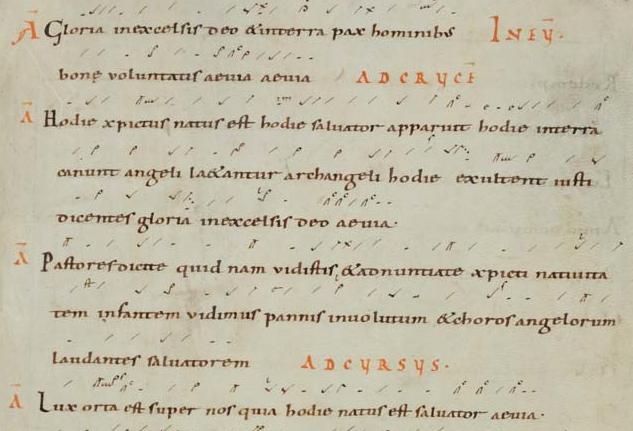
She was wondering about its antiquity. This piqued my interest, of course, so I thought I’d hop over to my favorite collection and check it out… Consulting the Winter volume of the Hartker Antiphonary (Cod. Sang. 390) I went to the folio for the Gospel Antiphon at Vespers and found the following:

As you’ll recall, scribes weren’t always picky about their line breaks… The “In Ev” in the upper right lets us know that the next line will be a piece used with the Gospel (Canticle); the red A in the left margin tells us that this line is an antiphon. Clearly this is not the antiphon we’re looking for, though.

Paging back, however, I ran across this:

Here we have the end of Lauds. The first line in this clip is the Gospel Canticle on the Benedictus which is the same as what’s in the Liber. That’s the end of Lauds proper—then we find our missing antiphon!

What we get are two antiphons here before we arrived at the antiphons used for the Little Hours during the day, the start of which is signaled by the “Ad Cursus” (For the Round of the Day) rubric at the bottom of the clip. These two antiphons are marked “Ad Crucem” which lead me to believe that it’s being used as part of the Common Commemoration to the Holy Cross. Typically these involve the use of an antiphon, a versicle and response and a concluding collect. This book tends to have them following Lauds and occasionally after Vespers. I’m not clear why there are two here, however…

Interestingly the Portiforium of St Wulstan from around the same time shares the Lauds antiphon but has a different Vespers antiphon (the “Lux orta” that the San Gall appoints for Prime, actually). The “Hodie Christus natus est” doesn’t appear in that book at all. Nor does it have antiphons for commemorations.

All of the English monastic breviaries studied at the Cursus Project use Hodie Christus natus est for the 2nd Vespers of Christmas with one fascinating exception. The Worcester Antiphoner uses the same 2nd Vespers Antiphon that we saw in the San Gall manuscript and the Hodie Christus natus est doesn’t appear until St Johns day where it is used as a Commemoration of the Nativity (Again, antiphon, versicle & response, then a collect—this time the one from Christmas).

The Sarum Breviary, following in the footsteps of the others uses the now standard Hodie Christus natus est.

So, that at least fills in a few points in regard to the history of this particular antiphon and its circulation in Northern Europe and England.