[I submitted the following thoughts to my fellow members of the SCLM in advance of our discussion tomorrow.]
Introduction
When Dr. Meyers informed me that we would spend some time discussing Holy Women, Holy Men at this meeting, identified the material she was circulating to the group, and asked if there was any additional material for inclusion, I had hopes that I would be able to complete in time a formal response to the ATR paper that she had written along with Dan Joslyn-Siemiatkoski. As I worked on it over the past week it has become abundantly clear that I will not be able to give it the care it deserves and circulate it with enough time for it to be read in advance of the meeting. Rather than producing a comprehensive argument, I thought it might be helpful to jot down the major concerns that I have with HWHM and that others have mentioned to me either on my blog or in person.
Before I begin with these concerns, though, I must start by acknowledging that a tremendous amount of work has gone into this project. My intention is neither to denigrate nor attempt to undo that work. To that end I’ve already reached out to Bishop Alexander (whom I know well as my former diocesan) to request his perspective on HWHM. Rather, I believe that the current state of HWHM serves as a foundation that can be built upon and refined to craft a high-quality, theologically-grounded Calendar reflecting our multiple diversities that can be proudly claimed by the whole Church.
The other point which must be stated—and cannot be overstated as we approach this work, I think—is that the Calendar is the official record of individuals commemorated throughout the transnational Episcopal Church. Entry onto the Calendar is not what makes a saint. Furthermore, not being included on the Calendar does not prevent an individual from being a saint or from being honored as one.
The calendar is, currently, our sole practice of social memory which is the process by which societies and organizations connect themselves to the past and make statements by reference to people and events of the past concerning their present identity. Being included on the Calendar means that an entry has particular bearing on who we are and what we do as a body of believers. Furthermore, the balance of the various kinds of saints says something significant about how we construe our priorities as a church and what roles and disciplines we value. The Calendar’s role in defining and directing Episcopal self-identity must be carefully guarded lest the Calendar become the property of one faction or another rather than being a collection that can be embraced by the whole church.
Clarity on the relationship between the Baptismal Covenant/Baptismal Ecclesiology and an Episcopal theology of sanctity
One of the foundational discussions of sanctity in Scripture occurs within the Pauline writings. In the two great letters on the church—1 Corinthians and Ephesians (with a healthy dash of Philippians thrown in for good measure)—a vision of Christian life emerges grounded in the principle of imitation. This vision is succinctly captured in Ephesians 5:1-2: “Therefore be imitators of God, as beloved children, and live in love, as Christ loved us and gave himself up for us, a fragrant offering and sacrifice to God.” To read this as an individual call to an individual person would be incorrect, however, for this is the capstone of a broader discussion in the chapter before. Chapter 4 is a sustained argument to “lead a life worthy of the calling to which you have been called” (Eph 4:1). The gifts of the Spirit are not just for individual edification but for a grander purpose:
To equip the saints for the work of ministry, for building up the body of Christ, until all of us come to the unity of the faith and of the knowledge of the Son of God, to maturity, to the measure of the full stature of Christ. We must no longer be children, tossed to and fro and blown about by every wind of doctrine, by people’s trickery, by their craftiness in deceitful scheming. But speaking the truth in love, we must grow up in every way into him who is the head, into Christ, from whom the whole body, joined and knit together by every ligament with which it is equipped, as each part is working properly, promotes the body’s growth in building itself up in love. (Eph 4:12-16)
In Baptism, all Christians are grafted into the Body of Christ; however, incorporation into the Body of Christ does not automatically confer the Mind of Christ. As individuals we must grow to maturity, but our own maturity can never be fully separated from the rest of the community. True maturity, a faithful imitation of Christ, is constituted by a relationship with Christ and his Church, a relationship rooted in faith and made visible in works of love that communicate Christ and bring the rest of the Church towards maturity as well. This is the life of discipleship. But what does it look like in practical terms?
As Episcopalians, this is where we can turn to the Baptismal Covenant. Following the rite in the prayer book, a life of discipleship minimally means:
- believing in the Triune God as revealed in the Church’s Creed
- continuing in the apostles’ teaching and fellowship, in the breaking of bread, and in the prayers
- persevering in resisting evil, and, whenever we fall into sin repenting and returning to the Lord
- proclaiming by word and example the Good News of God in Christ
- seeking and serving Christ in all persons, loving our neighbor as ourselves
- striving for justice and peace among all people and respecting the dignity of every human being
This is a life grounded in the faith of Christ and that reflects that inward belief and personal transformation in outward action and corporate transformation. If the Baptismal Covenant reflects our core understanding of discipleship, then our definition of sanctity must necessarily be rooted in the keeping of the Baptismal Covenant. After all, a covenant is an agreement between two parties: God makes promises to us, but we also make promises back—the transformation of discipleship is, among other things, about us holding up our end of the bargain! One aspect of the saints, then, is that these are mature Christians who, in their keeping of the Baptismal Covenant, inspire the rest of us to do the same.
In using the Baptismal Covenant to frame our understanding of what makes a saint, two items need to be noted. First, the covenant relationship with God found in Baptism is not optional. It’s hard to be an exemplary keeper of promises you haven’t taken. Second, history tells us of a myriad good, moral, inspiring, and important people not all of whom need a place on our Calendar. Sanctity is not just a matter of morality or inspiration—it’s about incarnating Christ to the community in the pattern of a life shaped by Christian maturity.
The report from the Calendar Committee in the 1982 Blue Book contains a line which keeps coming back to my mind because it so succinctly challenges a facile understanding of the saints and why we remember them: “It is essential that the prime criterion for inclusion in the Calendar continue to be (as is traditional) the witness of the person commemorated to the power of the Risen Christ, rather than a pedagogical desire to set certain persons forward as ‘examples’ for the faithful to follow” (Blue Book 1982, 146). To me, this quote focuses not upon specific actions or general types of action, but the way that each individual life in its totality shows itself to be an offering to the Church in and through the imitation of Christ and incarnating his message of love in its own radically particular time, place, and situation. Do some entries in HWHM focus on certain exemplary deeds rather than a life suffused with Christ?
The Eschatological Implications of Baptism
I focused on this angle in the Living Church article so I won’t rehash it here but to note the high points. Because of the nature of our life-in-Christ due to Baptism, the whole Christian community is eternally present as Christ is present. The saints are fellow-workers with us now. The collects give me the odd feeling of talking about someone in the room as if they were not there—we talk to God about the saint as if they weren’t part of our immediate worshipping community.
Too, we likewise fail to acknowledge how the individuals identified might feel about being included on a Calendar of this kind; Calvin and Barth must not be too pleased given their own thoughts on the saints!
Sufficiency of the Criteria
Since the publication of the proposed sanctoral calendar for the Episcopal Church in 1957, three sets of selection criteria have been put forward.
In the 1982 Blue Book, Thomas Talley presented a work entitled “The Passion of Witness: Prolegomena to the Revision of the Sacred Calendar” that included five criteria for inclusion: 1. Historicity; 2. Christianity; 3. Significance; 4. Historical Perspective; and 5. Memorability. Talley ends by saying that this list is not intended to be exclusive:
While other criteria may be appropriate or needed, and while suggestions toward them are invited, these have been set forth as consistent with the theology of sanctoral commemoration which we have articulated and which we take to be fundamental to further development of our celebration of the victory of Christ, “in memory of those athletes who have gone before, and to train and make ready those who are to come hereafter.” (Blue Book 1982, 161)
During the vote to add 7 new names to the Calendar in 1985 and the subsequent argument in the House of Bishops over the appropriateness of Aelred and Edmund, the Bishop of Texas made an amendment that the SLC present a report to the 1988 convention that contained “clear and detailed” guidelines that would govern the inclusion of new names. This passed as resolution 1985-A092. The following convention saw resolution 1988-A097 that presented Talley’s criteria with only a few changes in wording (like the clarification that two generations of perspective is equivalent to fifty years, hearkening back to the Lambeth study on saints which recommended the same length of time).
Also in 1985, the SLC rather sourly submitted a resolution (with the pointed note that it was submitted, not recommended) adding Charles Stuart—aka King Charles the Martyr—because the House of Bishops had expressly desired it to do so, and it was canonically required to obey. This resolution (1985-A094) was tabled and died upon adjournment. However, Charles returned at the head of resolution 1991-A119 and, in combination with 1991-A118, made this the year of Calendar Backlash at convention. The list of names for final authorization recommended in 1991-A118 was savaged, the House of Bishops rejecting all but one of the entries and demanding a rationale for the rest at their next meeting. The Deputies fought back and insisted that two entries be replaced (Bride and Underhill). The Bishops relented and the resolution was passed. With the appearance of 1991-A119 and a list of names book-ended by King Charles and Thomas Becket, the committee scrapped the resolution wholesale and submitted in its place a strongly worded reaffirmation of the 1988 criteria, a demand for expansion of the criteria particularly around the concept of martyrdom, directed a wider circulation of the criteria, and tasked the SLC alone with historical inquiry and the provision of material around candidates pointedly preventing the House of Bishops from submitting names directly.
As a result of the Caroline Martyrdom Controversy, the SLC brought forward 1994-A074 which altered and expanded upon the Talley criteria. It offered eight, the first of which gave a much clearer definition of martyrdom: 1. Heroic Faith; 2. Love; 3. Goodness of life; 4. Joyousness; 5. Service to others for Christ’s sake; 6. Devotion; 7. Recognition by the Faithful; 8. Historical Perspective. While Talley’s criteria put forth a good set of generalities, this set is superior. Sanctity and its criteria don’t just fulfill one function; it isn’t just about who goes on an official Calendar. A robust set of criteria for sanctity serves as a working definition of the life of discipleship—it offers a plumb-line for the practice of the faith and puts flesh on the bones of Christian maturity. What Talley presented were procedural guidelines. Enshrined in 1994-A074 is a roadmap towards a life hid with Christ in God.
Connected with the criteria was also a process. Brought up in criterion 7 and documented in sections III and IV, this resolution outlines a process where commemoration begins at the local level, gradually grows and attracts more attention, and—if there is enough momentum and conviction that this commemoration should become a church-wide phenomenon—a formal proposal may be made. In such a case, “documented evidence of the spread and duration of local commemoration is essential to include in the proposal to the Standing Liturgical Commission.” Section IV identifies the requirements for National (now “Church-wide”) Recognition including 3 or more bodies participating in the process and a formal proposal containing “a detailed rationale for commemoration based on the Guidelines (above) and demonstrating how this person manifests Christ and would enhance the devotional life of the Church,” a biography, “information concerning the spread and duration of local or international commemoration of this individual or group,” and proposed collects and readings.
This is quite a process and includes quite a lot of devotion and documentation. As a result, it comes as no surprise that the 1997 Blue Book, after citing the complexity of the process, contains the following note: “no new names have come before the commission” (Blue Book 1997, 282). However, beginning in 2000 and continuing in 2003, names began entering back on the resolution docket headed—ironically—by Florence Nightingale, one of the entries specifically rejected by the bishops in the Calendar Revolt of 1991. In each of the cases, I wonder if the proposals mandated by 1994-A074 were duly submitted. The process was required; was it followed?
Following resolution 2003–A100 which directed the work that would ultimately become Holy Women, Holy Men, the Blue Book 2006 states that the Calendar Committee “created new principles of revision as agreed norms within which the proposed revision would be developed” (Blue Book 2006, 131). The set of 10 criteria offered for approval in 2006-A057 are these: 1. Historicity; 2. Christian Discipleship; 3. Significance; 4. Memorability; 5. Range of Inclusion; 6. Local Observance; 7. Perspective; 8. Levels of Commemoration; 9. Combined Commemorations; 10. Common of the Saints. Looking at the source of the criteria, the first are largely those of Talley (1, 2, 3, 4, and 7) borrowing only the principle of local observance (6) from the 1994 set, and introducing four new principles (5, 8, 9, and 10). While only 1 criterion was adopted from the 1994 set, its procedure was retained largely intact requiring the proposal with its documentations, particularly to local observance. It should be noted, though, that the present criterion 7 n local observance was weakened by being deemed “normative” but not necessary. Although 5 is new in its inclusion among the criteria, it reflects a concern with diversity in the Calendar which was expressed by Talley and the Calendar Committee in 1982 and reaffirmed by several resolutions in the intervening years particularly focusing on the inclusion of women and people of color.
In 2009, a textual revision was made to criterion 3 on Significance. Candidates may either exemplify heroic faith or “They may also be people whose creative work or whose manner of life has glorified God, enriched the life of the Church or led others to a deeper understanding of God;” this alteration was passed in resolution 2009-A098 though not without an attempt (albeit unsuccessful) to strike the new addition.
My chief concern is the shift from 1994 to 2003: these are—once again—procedural notes rather than a vision of the sanctified life. Certainly a sanctified life is referenced in criterion 2 and is connected to living out the Baptismal Covenant, but is quite spare when viewed against the 1994 provisions: “What is being commemorated, therefore, is the completion in death of a particular Christian’s living out of the promises of baptism.”
I see a need in the Church for a stronger vision of discipleship. Evangelicals may talk about the “Purpose-Driven” this and that, but we as a Church have been poor at providing a purpose, a goal, for the Christian life in general and a spiritual life built around the prayer book system of spirituality in particular. What we offer the world is a sacramental path to discipleship. Our official Calendar of saints should be a straight-forward proclamation of what that looks like and offer a crystal clear vision of Christian maturity backed up by the biographies and lives included therein.
Faithfulness to the Criteria
While I would like to see a stronger set of criteria, a failing of the present work is that it is not even faithful to the criteria it offers.
Historicity has once again become an issue. This was a particular hobby horse of Prayer Book Studies IX which insisted that anyone commemorated be historically verifiable. In particular, it memorably vented its spleen on St. George:
The fact that he has become a patron saint of England does not make him any the more real; nor does it necessitate making him a saint of the American Church. Fairy-book tales may indeed be edifying. When they become part of the folklore and tradition of a great nation they can become stirring symbols. But it is asking too much of the majority of our American Church membership, who have no such traditional and patriotic associations with the name, to respond with mature devotion to a saint of whom it can only be said, “He may have existed, sometime, somewhere.” (PBS IX, 36)
The appendix to the study also included a set of saints celebrated within the Anglican Communion but not recommended for the American Church; some of these were on historical grounds notably Valentine, George, Anne, Cecilia, and Catherine. The middle three now appear in HWHM. Has new evidence of their historicity appeared in the last fifty years? Furthermore, Lucy is back who was one of the saints who was presented then disappeared after the Calendar Backlash of 1991. (And I do note these with a certain regret as, like many Anglo-Catholics, I have a love for the martyr saints of the persecution years.)
The “50 year” clause of the Perspective criterion is a clear case. Either someone qualifies on a mathematical basis or they do not. If they do not qualify for church-wide recognition on mathematical grounds, then the promotion and observance of a local commemoration—as directed in the criteria—should certainly play a role in keeping the commemoration before the faithful until the required time has passed.
Baptism is explicitly listed as a requirement for inclusion in criterion 2. Rabbi Goode of the Dorchester Chaplains has been often and publicly cited as a failure of this criterion in public debate. No one is saying (certainly not within my hearing!) that Rabbi Goode is any less of a heroic witness of faith for his lack of baptism. But he is a heroic witness of the Jewish faith, not the Christian faith, and for us to co-opt him as one is quite insensitive to him and his tradition. Especially as we seek to tie the Baptismal Covenant and a baptismal ecclesiology to a theology of sanctity, baptism must be required for entry on the Calendar. Again—I say this with regret—if Anne and Joachim, parents of the BVM, need to be removed for the sake of consistency, so be it.
The most complicated criterion to apply and yet the arguably most import is criterion 2 on Christian discipleship. All other criteria—and here I’m looking specifically at that added line in criterion 3—are subject to it. Indeed, the presence of 2 is why the wiggle-room provided by that line in 3 does not bother me. However, in the definitional reduction between 1994 and 2003, applying additional sufficiently fine criteria around “the completion in death of a particular Christian’s living out of the promises of baptism” is complicated. One thing that we can say, though, is that those who chose to turn their backs on the church and its community will fall short of this criterion. According to my limited knowledge, this would disqualify people like W.E.B. DuBois and John Muir. And, if the “promises of Baptism” include fidelity to the creeds with which our Baptismal Covenant begins, then the case of Florence Nightingale (and possibly others) does need to be examined again.
The Number and Growth of Commemorations
The sheer volume of people added to the Calendar in HWHM is problematic. Particularly with the addition of so many names, I am concerned that we are not able to give each commemoration the attention it deserves to ensure that we are selecting the finest examples of Christian maturity who will inspire us to a similar maturity. While I am sure that there is an official table that contains all the data pertinent to HWHM, I have not yet seen it and fall back on my own resources; my initial sweep of calendrical proceedings over the past 50+ years yields the following graph:

The next logical question is this: where do we stop? When are we done? We’ve already begun adding multiple commemorations to some days—will we go until there are no ferial days left?
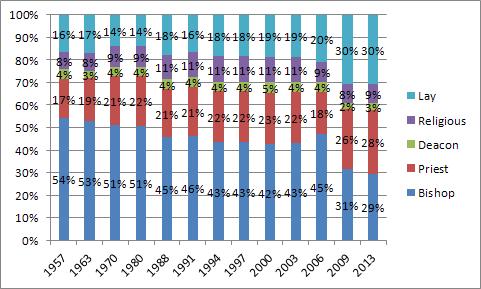
On the practical side, the growing number of commemorations causes problems for our diversity statistics. Based on my unofficial data this is the gender balance over the years:

Attention was first explicitly drawn to gender in 1982 and we see an immediate improvement in the next edition of LFF released in 1988. We have seen improvement with the influx of names in the introduction of HWHM in 2009, but women haven’t broken the 20% mark yet. It seems unlikely that the percentage will get much better without some sort of drastic intervention such as the removal of quite a number of men and the continued addition of women.
The Professionalization of the Calendar
As mentioned in my Living Church piece, I have difficulty with the way that we are clustering professions: architects on December 16th, artists on August 5th, composers on July 28th. Indeed, when you come right down to it, I have an issue with criterion 9 which advocates linked and combined commemorations. Again, going back to a baptismal basis, clustering commemorations lessens the individuality and therefore the witness of the people commemorated. Clustering draws attention to and exalts the “type” rather than the human life that bore witness to Christ. Yes, Christians of all professions can be and have been saints—but I fear that this gathering leads to abstracted types and examples rather than the witness of resurrected lives.
The “Modernization” of the Church
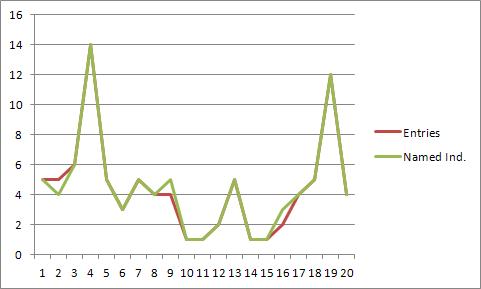
As I mentioned at the outset, the Calendar is a practice of social memory and it functions as a collective rather than a group of discrete individuals. After all, this is why diversity in the collection is important… The composition of the group matters and says something about how we understand our Church as a group and our selection of important people and events. Not just the individuals but the balance of the group is a powerful expression of group identity. One of the effects of the huge influx of names is a sudden disproportionate effect upon the balance of the church over time. This graph tracks the count of named individuals by the centuries in which they died according to the main points in Calendar revision:

In the proposed Calendar of 1957 there were observable spikes at the 4th century, the 13th century and the 19th century. Now the graph is completely dominated by the modern period. There are more saints in the last three centuries than in the seventeen leading up to them. The implicit message is an embrace of temporal myopia: we only recognize as important those people and events that have occurred within our immediate past. The converse is that we do not value our past and our connection to the church of our ancestors. Are we a church that sees ourselves in continuity with the baptized through the ages, or are we a church that understands ourselves as a recent phenomenon?
The Category of “Prophetic Witness”
In HWHM there are 23 individuals within 18 commemorations who are identified with the epithet of “Prophetic Witness.” I have two issues with this category. The first is that its use implies an exclusive property. Our Commons are drawn in such a way that they are not the air-tight categories of former days (Bishop-Confessor-Doctor, Virgin-not-Martyr, etc.) but are flexibly open. Nonetheless, they define particular areas of effort and focus: Pastor, Missionary, Theologian/Teacher, etc. Introducing Prophetic Witness among them seems to indicate an area of focus. I’m sympathetic to that intention, but this is the wrong name. To retain this label is to imply that martyrs are not prophetic witnesses. And yet that is at the very heart of the Christian definition of martyrdom! As is well-known, the English word “martyr” is a loan-word from the Greek term for “witness”; to suggest that there is nothing prophetic about being willing to give up your life for your faith is crazy! Likewise, monasticism represents a principled stance against the predominant principles and values of a society. How is this not a prophetic witness? Indeed—most of the saints on our calendar represent a form of prophetic witness because a life of discipleship will always stand out by means of its virtues, character, and disciplines of life from those around it; it will be a witness of the resurrection that will always challenge the power structures around it.
This leads to the second issue—the category is euphemistic; the use of the term imbues it with an artificial gravitas. A more accurate epithet would be “social reformer,” “renewer of society” as used in the Lutheran calendars, or “social progressive.” After all, as a thought-experiment, it could be argued that in his fight to preserve the rank of Bishop from the Puritans, Charles Stuart was being prophetic to the prevailing society around him. Could he then be called a “Prophetic Witness” and fit in the company of the others? Of course not! What would distinguish him from the others is that they sought to alter the status quo while he sought to preserve it. Again, we believe the Gospel calls us to personal transformation and to extend that transformation and liberation into the culture around us; this is a helpful and necessary category—but it needs a more accurate name.
Clarity on Liturgical Function
It is clear from the time the Proposed Calendar appeared in Prayer Book Studies IX that the propers provided were intended for Eucharistic celebration and were never intended to replace the in-course readings in the Daily Office. Explicit notice of this would serve to reduce confusion. I would think that in the section “Concerning the Proper” a line or brief paragraph could be added identifying the Eucharistic nature of the propers, but allowing that the collect can be used in the Office either as the Collect of the Day (governed by the order of precedence in the Calendar section of the prayer book) or in addition to the Collect of the Day.
Historical Almanac vs. Sanctoral Calendar
One of the fundamental questions before us concerns the nature of the document itself: is it an historical almanac or a sanctoral calendar? The line between the two can be fuzzy because, since we recognize only historical figures as saints and the saints ran their earthly races in the past, data about them is historical data. I would draw the distinction between the two in this way. An historical almanac is a record of people and events in the past that are meaningful to the group compiling it. It is a practice of social memory, but its entries are selected by a criterion of importance—the people and events are either important in their own right, say something important about how we see ourselves and our corporate identity, or both. A sanctoral calendar, in contrast, is a remembrance of individuals who stand as exemplars of Christian maturity and whose lives and witness call us to Christian maturity as well.
Some of the recent commemorations added in particular have been moving us in the almanac direction. Take, for example, the new trial commemoration of Virginia Dare and Manteo approved for August 17th. Virginia and Manteo were among the first people baptized in North America. At first glance, this looks like a really good idea: it grew out of a local diocesan commemoration, it adds needed diversity to the Calendar by giving us a woman and a Native American, and it focuses our attention on baptism. My issue is this: how does Virginia Dare’s life manifest Christian maturity and call us to the same? Unfortunately, this is really hard to assess because she was part of the Roanoke Colony that disappeared! There is absolutely no record of her life—only the fact of her baptism.
I feel torn with commemorations like this one because it does offer us something worth remembering—but is the place for it a sanctoral calendar? Perhaps one way to honor the work that has been done without confusing the categories is to issue an official almanac precisely for items like these that are significant and important but don’t meet the criteria or fit the concept for sanctoral celebration. An official almanac too would be a useful repository for information about important people who didn’t rise to the level of sanctity for whatever reason but whom it is important for the Church to remember. It might also be the perfect waiting place for those who have not yet crossed the 50-year threshold but whom we are still considering as candidates for the sanctoral calendar.
Again, thinking practically, moving some individuals into an almanac will give us an opportunity to redress the ongoing gender gap issue which has been put before us time and again—and mandated legislatively since 1982.
In Conclusion
Holy Women, Holy Men represents a lot of hard work on Church History and Episcopal History. For that it deserves our praise. But there are still issues that need to be addressed. The sufficiency of our criteria and our adherence to them stand first and foremost in my mind. The balance of the Calendar is also a crucial issue for how we describe our connection to the ages that have come before us; the current composition reflects a radically disproportionate emphasis on the modern period. There are other ways—notably an official almanac—that can be used to preserve this work and yet to keep the integrity of the sanctoral Calendar. I look forward to our upcoming discussion, and to the rest of the work that lies before us.