Author Archives: Derek A. Olsen

Gospel Tone Question

Ok—here’s a call for information. M has pointed Gospels before and has sung lots of Gospels other people have pointed. Yet, she’s not terribly pleased with the spare instructions in the back of the Altar Book or with the modern variants like Grace Newark that seem to tinker with the traditional method.

So, we have the instructions from the Altar Book; we have the examples of the three tones in the Liber Usualis, but we don’t have a clear set of rules for pointing Gospels.

As an example of what I’m thinking of, the St Dunstan’s Plainsong Psalter has a clear and comprehensible set of instructions for chanting the Lessons at MP/EP in Appendix II on pp. 270-275—What’s comparable for Gospels?

Positive Points from a Purple Shirt

Given the behavior of bishops the last few (yeah, ok, 18 hundred or so) years*, it’s always refreshing to see a bishop make some clear, cogent, and thoroughly Christian points. And these are the Canadian Diocese of New Westminster which—as I understand it—is one of the more divided dioceses theologically in the Anglican Church of Canada.

I’ll only editorialize one little bit and that’s to cite James: “But be doers of the word, and not hearers only, deceiving yourselves” (Jam 1:22). It’s important to think these things—but it’s not enough to congratulate yourself for saying you think them; they must be ennacted as well. And that goes as much for the bishop who spoke them as for the rest of us.

1.

Pray for the unity of Christians, for a spirit of charity towards those with whom we may disagree, and for God’s forgiveness of our mutual failure to honour the prayer of Christ in St. John’s Gospel “that they may be one.”

2.

Give particular support to those conservative and traditional Christians who remain with their church and grieve the departure of friends.

3.

Teach our members about the genius of Anglicanism and its balance of Scripture, reason and tradition within the boundaries of common prayer.

4.

Emphasize in our preaching and leadership the centrality of mission and its priority over ecclesiastical politics.

5.

Challenge the false stereotypes that foster polarization – e.g. the ‘heartless conservative’ or the ‘unbiblical liberal.’

6.

Give thanks that our church, for all its messiness, is honestly and openly facing issues some other bodies cannot.

7.

Press forward in ministry and evangelism at the local level.

8.

Deepen our study and immersion in Scripture. Place ourselves under the authority of the Christ it reveals. Avoid both an empty relativism and a harsh literalism.

9.

Encourage both local media and the non-churchgoing public to understand the deeper roots of this development.

10.

Take the ‘long view’ – i.e. remember the consistent triumph of the Gospel over the historic fragmentation of the church, and the persistence of faith through the failures of human discipleship.

Please remember our diocesan and national leaders in your prayers too. And above all, let’s get on with the normal work of being the church.

A big thank you to Lisa from My Manner of Life who posted it and a h/t to the Postulant for linking to it.

* Yes, I believe in bishops. As an Apostolic Succession believer I believe they’re necessary for the fullness of the Church. But I also believe they’re completely human and have ably demonstrated over the centuries their fallibility…
Advent Notes from the Liber Usualis

I was poking around the Liber thinking Advent thoughts when I came across two things I thought I’d share. The first was a rubric I’d never noticed before, the second a marginal note I’d written in a while back.

  • On tune changes: We talked a little while back about whether Office Hymns could be put to any ol’ Long Meter (LM:8 8 8 8 [that is, 8 syllables in each line of the stanza]) tune. Checking over the material under Advent I which is where any broadly seasonal stuff falls I say on p. 317 that the same tune is to be used for all the hymns of the Little Offices through Christmas. The tune indicated is a mode one tune that I know as Verbum Supernum Prodiens. This indicates two things to me:
    • In the Liber tradition at least, there is more of a disconnect between tune and text than I thought and
    • seasonal tune changes for these unchanging hymn texts are another way that the Seasons of the Church get filtered into the Office pattern which overall has far less seasonal changes than the Mass.
  • Name changes: Glancing at the Advent Vesper hymn, the Liber has “Creator alme siderum”; a marginal note I wrote in my Liber a while back indicates “Conditor alme siderum”. The difference is not in meaning—they both mean essentially the same thing, but points to some deeper issues. Notably, the Clementine Butchery when Jesuits from St. Louis Rome corrected the Office Hymns from their original texts to match Renaissance norms on order of the pope. These changes occurred only in the secular use (i.e., the Liber) but not in the monastic uses who wisely (I think) retained the original words. Again, this means two things:
    • Medivalists beware!: The Latin texts found in the Liber are not the medieval texts. To find medieval texts, always go back to medieval sources (like the A-S Hymnarium).
    • Cross-Referencers beware!: Typical practice in dealing with Latin liturgical sources is to use the incipit—the first few words of the hymn/antiphon/psalm/whatever—to locate the correct text. Because of these Renaissance changes, however, some of the most common hymns no longer share incipits. This has an impact both on medievalists looking for full texts of medieval hymn incipits but it also has an impact on people working from histoprical protestant or hymnal sources. Some of our favorite hymn translating/arranging antiquarians like Blessed John Mason Neale and Blessed Percy refer to the original incipts rather than the more recent ones. Needless to say, changed incipts make computer searches much harder as well; let the researcher take care…

Pullman Loses

Much has been made of Philip Pullman’s antipathy to Christianity and the film The Golden Compass based on his novels has been refered to as “Narnia for atheists.”

After seeing an ad for the film featuring a regal woman assisting the protagonists, Lil’ G turned to me and asked, “Hey Daddy, is Mary in that movie?”

A Bleak Glimpse Forward

Lee directs us to this sobering post on peak-oil, population, and food supply.

From the Rule, Chapter 48: On Manual Labor:

And if the circumstances of the place or their poverty
should require that they themselves
do the work of gathering the harvest,
let them not be discontented;
for then are they truly monastics
when they live by the labor of their hands,
as did our Fathers and the Apostles.
Let all things be done with moderation, however,
for the sake of the faint-hearted.

It seems clear from the passage above and others like it that Benedict envisions his monasteries as self-sufficient as possible. Certainly divisions of labor were well known in the economies of his day as well as later periods—but Benedict praises the manual labor that produces the community’s needs as worthy of true monastics.

In this day and age, I don’t see self-sufficiency as practical or even desirable for most of us, and yet I know there’s more that we can do. M and I have always dreamed of being able to have a big garden where we can grow more of our food than we do. M has been working on identifying locally-grown organic foods for our table.

Benedict has examples scattered through the Rule of what simplicity looked like in his time and place. As we consider our response to our various crises, I keep turning again to consider what “simplicity” can and should mean for us. Not just “consuming green” but re-accenting the motto people of our age grew up with: Reduce, Reuse, Recycle.

AAR/SBL News

The conference went very well. M and I did most of the things we wanted to: did some exploring of the city (and found this free gallery that has some nice icons and Old Master paintings), enjoyed the whirlpool, had some nice meals without children (though we missed them terribly), and met up with a bunch of folks–like Christopher, Mother Laura, and Anastasia. We took in some sessions as well (including Mother Laura’s paper on Perpetua and Felicity).

And we hit the book room. Restraining ourselves, we left as empty-handed as we came—but the book room was still a joy to behold…

Meet-up Location

If anyone on site is checking in reagard to this… We’ll be meeting at a table in the Cafe which is in the back portion of the Book Room. Bring food; M and I have discovered a good cheap option in the grocery store up two blocks or so on First.

 I’ll have a little sign… :-)

Deo Gratias

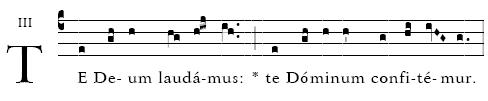
TeDeum

M was just offered a part-time job at a local parish entirely out of the blue!!

There shall be much rejoicing at our household tonight including the intoning of a solemn Te Deum of Thanksgiving…

Jesus on Marriage

In light of the earlier discussion on Christian chastity, I was struck by Sunday’s reading and noticed something in it I’d never seen before. Here it is with emphasis:

Luke 20:27-38 27Some Sadducees, those who say there is no resurrection, came to him 28and asked him a question, “Teacher, Moses wrote for us that if a man’s brother dies, leaving a wife but no children, the man shall marry the widow and raise up children for his brother. 29Now there were seven brothers; the first married, and died childless; 30then the second 31and the third married her, and so in the same way all seven died childless. 32Finally the woman also died. 33In the resurrection, therefore, whose wife will the woman be? For the seven had married her.” 34Jesus said to them, “Those who belong to this age marry and are given in marriage; 35but those who are considered worthy of a place in that age and in the resurrection from the dead neither marry nor are given in marriage. 36Indeed they cannot die anymore, because they are like angels and are children of God, being children of the resurrection. 37And the fact that the dead are raised Moses himself showed, in the story about the bush, where he speaks of the Lord as the God of Abraham, the God of Isaac, and the God of Jacob. 38Now he is God not of the dead, but of the living; for to him all of them are alive.”

From Oremus.org’s NRSV.

Luke has Jesus making a contrast between two ages. These ages are not temporal, rather, they are paradigms of existence. He opposes “this age” (i.e., the present age, the status quo) with “that age” (i.e., those worthy of and who will participate in the resurrection; read with Christian eyes=us).

The explicit message of Jesus on marriage, then, is that children of the resurrection don’t do it…